
Do You Understand Antichess?
Understanding something at its core is simply knowing its meaning, but from there it expands in a network with an infinite periphery to what we derive and conclude it.Proem
'Neath dim lit candle on a stormy night. A feather's tip, coiled in black ink, brushed the parchment. With a question mark to finish the sentence, it calligraphed its way onto paper. The remainder to be left blank, as he deemed it unanswerable. Let's explore the question.
I want to philosophize about this, putting aside the scientific approach that are the rules, and the 'best' move derived from these rules to any given position in the game. 'Deriving' having the meaning of 'Stockfish says this is the strongest move, so it is the strongest move.'
To you, dear reader: I think this blog can be of great value to your playing. But I recommend asking yourself this: Do you understand antichess? If the answer is yes. Great! Please continue reading.
Also, consider this blog a critic's view, a counter-perspective, about this blog by @tolius.
Something to think about: 1. e3 isn't the strongest opening. Yourself, your opponent, time control, tournament, single game/series of games etc. Therefore 1. e3 can't always be the strongest opening.
Which Antichess Player Am I?
As of late, I found joy in playing weird stuff – for people that know me: Yes! even for my standards, I for once agree that I am playing weird stuff. As I am writing this, I recently jumped to 2310 with theory stuff in 0+2, ½+0 and 1+0, got bored, played some blitz, started playing ‘weird’ stuff again, and almost dropped below 2200 over the span of 3 days.
The player I think I am (you can take these with a pinch of salt):
Cons:
- I tend to forget any theory, especially what I studied beforehand, so I have to analyse a position and evaluate everything and make my move. I can do that in the span of 1 second or 10 minutes with varying results.
- I often rush, making unnecessary blunders in, to my frustration, favorable positions.
- Limited opening book, making me easy to prepare.
- Bad at bullet.
Pros:
- Mentally strong
- I ‘understand’ antichess
- I eat them good ol’ processed foods called Kellogg’s
Something to think about: which player are you? To keep this blog readable I kept it quite short about myself, but let’s say we brainstorm together about who you are over a beverage. You might learn a thing or two about yourself.
A Community of Antichess Enthusiasts
So... you can find me being active in a certain Discord server where, for some reason, people are classified as non-theory players and theoretical players (myself being classified as non-theory). To my understanding: a theory player plays theory, a non-theory player doesn’t. But what is theory?
Theory seems to have a very shallow definition when it comes to antichess. For good reason: with forced capture, the flexibility of a position is often limited. Many moves instantly lose. So theory has to be all moves that aren’t losing? And on top of that, 1 move is the ‘best’ move while others have a significant negative impact on your eval.
And about that best move: a best move is labelled so because 1.000.000 different move sequences that possibly come after it make it out to be, because the subsequent position seems to be favourable for you. But do you understand these 1.000.000 different moves?
Also, theory and the antichess community seem to be obsessed with that eval number. Which I don’t understand. The eval doesn’t state if an opponent understands the idea behind your moves (nor his own). To continue: eval doesn’t discriminate in the slightest, it ‘understands’ antichess in a way as if it is a variant made of statistics, factors, values instead of numbers. The eval does not know the circumstances under which the position arose.
Should the eval discriminate? Well, no. It’s simply impossible to turn everything (and I mean, absolutely everything) that is antichess into a measurable number. Should we discriminate? Well, yes, when it comes to playing antichess and theory/non-theory, we should. Why? Our opponent isn’t a statistic, nor the setting in which the game is played. We should adjust our playing to the setting in which we are playing the game. To elaborate on this: An eval of +4,3 doesn’t necessarily state that you are winning. Instead, it rather describes a position, yet it doesn't define it. I mean, an opponent could’ve played suboptimal moves on purpose to get you into that position because he knows a trap that you don’t. In the Amsterdam Antichess OTB you see discrimination all the time! 1. e3 is an opening often avoided as people understand that their opponent is well prepared for that. So they go with something else.
Something to think about: What makes you make a move? Not just the opening, but delve deeper. Late mid-game where you spent 20 seconds on a move. Or an endgame premove. The answer might be straightforward, or is there more to it?
How to understand the game?
Let’s take our time here, shall we? I mean, I believe a blog has a near unlimited amount of characters? So might as well use all of them.
Introducing our VIP's:
Pawn:
The pawn can block or pave the way for opposing pieces as well as your own. Antichess is deeply concerned with board control and manoeuvrability. And moving the correct pawn to increase your manoeuvrability is vital for success. Looking at 1. e3 . This paves the way for the queen, bishop, king and knight.
So, you probably know a thing or two about e3. But I want to emphasize the why here. We don’t have to delve deep into theory. When making a move look at what it enables/disables for you, and for your opponent. Do so for every move, and you’ll probably start finding stronger moves than you did before.
Pawns are maybe the most complex piece on the board. The truth of this statement lies within the fact that understanding the pawn and the position it is in is probably the most obscure to fully comprehend. It isn't as plain as to what piece and squares it is guarding, rather, look a step further: how a pawn disallows the knight out of its starting square, disallowing the rook into the game, forcing you to bring something else out. In that regard, the activity likely switches to the other side of the board. You're probably busy developing your boardstate. And forget to understand the value of a pawn being so active on the board. Remember that pawns really command the flow of an endgame, and since that is so important, why not invest into understanding the way of the pawn on its way to promotion? I'm talking about the causality of the pawn here.
The correlation and causality of the game and its pieces are the key to understanding the piece. Major pieces tend to be more straightforward: a diagonal opens, the piece comes out, and is sacrificed. But we play 1. g3 and the pawn stays in that square for a prolonged period of time. Arguably the effect that pawn has on the game is larger than any piece will ever have during that game.
Something to think about: As with other pieces, a pawn's position is strong depending on the board state. Move them to increase your maneuverability or to limit your opponent’s. The light square bishop is often sacrificed in the e3 opening. Have you ever considered to keep your pawns on light squares in the middle game to prevent your opponent from sacrificing the dark square bishop? Maybe you can trap that bishop?
Knight:
Limited in its movement. Always moves from a light to a dark square and vice versa. Needs support to utilize. Meaning, let your pieces work together to get the best version of themselves. An example of this: 1. Nh3 e6 2. b4 Bxb4 3. Rg1
The knight is supporting the rook here: You allow space for your rook, and on top of that, Rg1 is very unconventional as rooks tend to be moved out of their starting square quite late in the game. So you could argue that this is a very strong position for white. To visualize that statement: Change the flow of a river near the ocean and you won’t see much change to the environment. Do so more inland, and the effect is enormous.
For the endgame, knights tend to be very weak most of the time. Promoting pawns to them usually leads to defeat. Still, quite commonly, if the promotion deems too difficult to calculate, people decide to take a knight and hope for the best. A valid choice, as pawns, apart from capturing, also move from a black to a white square and vice versa. So albeit a losing piece, it’s very difficult for to calculate the sequence completely, leaving many room for mistakes. Rooks, queens and bishops might be stronger on paper, but their playing is far more straightforward.
Something to think about:
one knight to move is weak towards all, two knights will have your opponent’s fall, three knights will make them crawl.
Bishop:
Here comes my opinion: A horrendous piece, a nightmare, an endless pile of problems, the spawn of Satan. It’s evil, vile, disgusting.
Why? Thanks to the bishop, d3, d4, e4 are all losing openings. Bishops pressurize your own board state before you even make a move. The best openings? e3, g3, b3! Because this limits development for your opponents and now their own bishops are the problem.
The bishop is creativity’s sole enemy. The piece itself lacks creativity: it’s either always on dark squares or light squares, and limits the pieces that want to become creative (like pushing a pawn, because that opens the bishop’s diagonal).
From a creative standpoint: e3 should be your go-to move, so that you can sacrifice the problem. But then again, 41% of all registered Lichess antichess games are e3. So creativity's 2nd problem is: the most theory exists for this e3 opening. So to master e3 and get creative somewhere, a large opening book is required, but then again we will be so far into the game, that few pieces are left, so there is no creativity left. So yes, the bishop is antichess’ biggest problem. Sign me up for 4 knights instead of 2.
Alright, with that of my chest, I’m afraid we will have to share some valuable information about the bishop now (honestly, at this point I’m truly searching for something positive to say about this piece).
If there is one thing to admire about the bishop, it’s its unmatched efficiency. The bishop isn't a brawler; it's a precision instrument. On an open diagonal, a single bishop can slice through your opponent's board like a scalpel, forcing a mandatory capture sequence of four or five pieces in a split second. When you are the one holding the handle of that scalpel, the bishop transforms from a nightmare into the ultimate clean-up tool. It is the fastest way to empty the board when a tactic hits right.
Something to think about:
The bishop only sees half the world, but it rules that half with absolute tyranny. Are you using the bishop to attack, or are you letting its colour-blindness trap your own pieces?
Rook
Arguably the all-star in antichess. Slightly less flexible than the queen, and that grants just the edge over her. With many pieces being sacrificed. The rook comes alive. Very good at attacking specific squares on the board, but also to defend files and ranks to push your opponent into corners of the board. It’s the strongest endgame piece. Only one weakness to find: both rooks start on the back rank, and more often than not: you are on the verge of that endgame, and there you see both your rooks still on their starting square and now you run into back-rank paralysis.
Luckily, many moves precede an endgame, and therefore we can adjust our middle game so that we have an improved endgame position.
Something to think about:
consider why an opening works for you and what the ‘nature’ of your endgame is. Develop the rook at a different stage, and look how the game might age.
Queen:
She deserves her own blog to be honest. I might even do so some time in the future. Keep her in the game please, and unleash her at the right moment. She grants you an escape route: your position has turned dire? Let her run free, and a queen race might grant you victory.
The very best players advise to avoid a queen race altogether, and those same players say: don’t ever end up in a queen race with Kellogzz. I think what they meant: Don’t do queen races if you don’t know what you’re doing. It’s a shame I can’t show a hard statistic here, but I’m quite sure my queen racing win rate could be above 80% .
‘The queen race is a lottery,’ a hater might say. But I would argue that you simply lack the depth of understanding what a queen race is (the depth of understanding a queen race is something that definitely deserves its own blog).
The frail list of antichess literature released states unanimously that the queen race should be avoided. Here’s my take on why that is true:
You develop pieces for... development. And in doing so, you hope to do it better than your opponent and win the game. “A pawn here, a knight there... Yes! That way... my opponent can’t do anything – including getting the queen out to start a queen race – and I win!” Starting a queen race pretty much nullifies all preparation that came before it.
My own playing rarely involves 1. e3, therefore at some point in the game I play c4 to open the diagonal for my queen, so that, if necessary, I can start a queen race, or at least, my opponent has to keep an eye out what to develop on his own side, or he might enable me to.
Something to think about:
Bringing out the queen is not about luck; it's about timing. Can you find the pattern that tells you the board is ready for her? Anything paticular about a position that stands out why you bring her out in the open?"
King:
Quite an intriguing piece I might say. Limited movement, yet flexible enough so that you can utilize it for many different roles. He pretty much does everything for me. Defending/attacking squares, supporting pieces, setting up traps. Solid, solid piece.
It is often involved in the endgame, and its strength is often characterized by how much it has come or sometimes hasn’t come forward. Its versatility needs to be carefully analysed, and if done properly, can be turned into your strongest piece in many given positions during an antichess game.
Something to think about:
Many theory is based on a position with a not-so-active King, consider its strength if it would come off the back rank earlier. How that affects the game and especially the pawns that are yet to get across the board for promotion.
The Meta
To my disappointment, as is with regular chess and the other variants as well, speedy time controls are preferred by most. Looking at the games, they are... rigid, lack any depth and mostly lost over a blunder rather than good playing. Speed is rewarded instead of the game itself. Depth having the meaning here that a position is actually explored, of course a move granting a mate in 25 is deep, but remembering a sequence is not something I call deep, nor understanding the game.
Fast time controls don’t offer themselves for the insightful approach to the game that this blog (tries to) portray. There are many, many places to explore in the antichess universe, but we keep being drawn to what we have been doing since antichess first appeared on Lichess.
Tournament games are most popular, also a difficult way to utilize the understanding of the game. We often rely on the same opening, as we face someone random, we don’t know what they play, so we rely on what we know. That’s when the stalemate happens. We don’t develop, we don’t find a different path.
The meta tends to run towards 1. e3. Whether you are a beginner, intermediate or expert. You'll see that most play 1. e3. Shallow, in the grand scheme of things, as we tend to rely mostly on our own frame of reference. We tend towards conformity when we want to explore the unknown, and rightfully so. While it is healthy to question the information that is given to us. You'd be wise to first have a basic comprehension of how it works. Once you've done that, develop what you know, improve on what feels right.
Something to think about:
We develop by analysing our games, but with the help of an engine, we nullify our critical thinking. An engine can tell you whether your conclusion was correct. It cannot tell you why you came to that conclusion. Make a move yourself, and note about it what you like and don’t like. And do you truly analyse the game? Or do you just check the moves? What makes you make a move? The engine won’t help you answer that question.
Structures
They come in all forms and sizes. Understanding/recognizing them makes playing the game easier. I’ll choose my words carefully here, as this part could become endlessly long, but let's have a look at just one, that should be enough to get my point across. A structure that was recently pointed out to me greatly helped me with my decision-making on moving a piece.
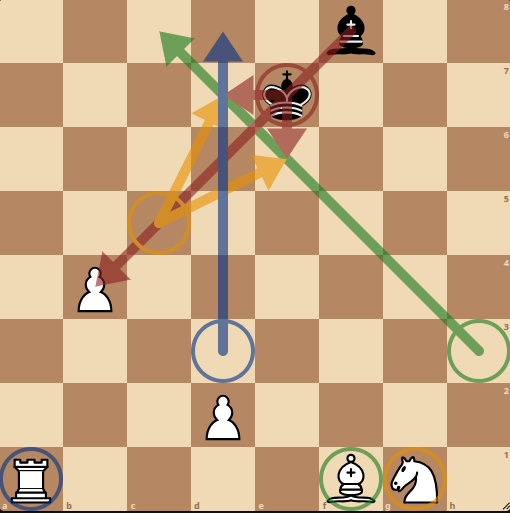
Ignore the position, I want to talk about the king blocking the diagonal of the bishop. It's a very common move to get your king in front of any of your two bishops to defend against a threat. So in late midgame we often see this happen. Now that I recognize this structure, I immediately look if I can exploit this and win the game. Often my pieces are positioned in a way that the bishop and king have no way out and I can turn the bishop into a loose cannon by utilizing some of the moves shown in the picture.
The patterns and structures of antichess are something you mostly acquire through experience. But the point at which you start recognizing them is the moment you should delve into analysis. What is the causality of the pieces in these structures? Answering that question will replace calculation with recognition. This will make you able to play faster. Improving your set of skills needed to become a strong bullet antichess player.
Something to think about: Structures are perhaps the closest thing we have to a physical form of correlation and causality.
About that question...
Right, how to understand antichess? It isn't up to me to define that really. As I am not the strongest antichess player out there. Yet I want to point out that @neverplayfastanti, considered as one of the very best, is scared of playing against me, because he considers me very dangerous and grotesquely underrated. GOD the day he said that my ego grew to epic proportions.
But back on topic. Understanding antichess is playing it, but also questioning how you are playing it, how others are playing it. But better yet, understanding yourself, as with that, you can ensure growth and improvement. Luckily we are all different human beings, therefore you have to look in the mirror and ask yourself what works for you.
Lastly I would like to highlight our frame of reference, as within it, we tend to look at what is closest to us. That fact probably explains why 1. e3 is so popular. We open the analysis board to learn what works and what doesn't, yet we are looking at a tool that doesn't tell you how or why. Instead it limits your view by that enormous blue arrow saying 1. e3
Something to think about
The fingertips touched the parchment one last time. Whether it was necessary or a habit, he blew over his signature to make sure the ink was dry. Satisfied he closed the tome. The night accompanied the cold winter storm. Closing the window, a final gust shrouded the room in darkness. Now the shadows were left without boundary. Free to roam where light wouldn't gloam.
As time passed. The ink spread from its papers abroad. Sure as hell, it wasn't for the author to gloat. Now for the world to see, from a critic's view it cannot flee.
You may also like
 tolius
Antichess: 1. e3 Wins for White in #79
The title of this blog is a reference to the 2016 article by Mark Watkins, “Losing Chess: 1. e3 wins… Kellogzz
A Dog's Guide to Antichess: No Thumbs? No Problem!
I wasn't supposed to get a keyboard. I usually chew on those, but here is my antichess adventure! thibault