
Bronstein vs Botvinnik: The Rivalry
Explore one of the Greatest Rivalries in the History of Chess
David Bronstein and Mikhail Botvinnik are two of the greatest legends of the game. They had a rivalry spanning 23 years from 1944-1967.
Table of Contents
Prelude
First Meeting - 1944
World Chess Championship - 1951
1951 - 1967
Epilogue
Prelude
The crux of my career was the arrest of my innocent father Johan in 1937, on New Year's Eve.
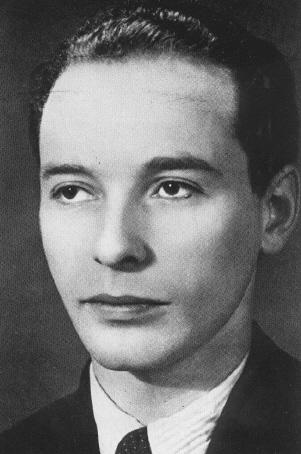 David Bronstein.
Bronstein: He held out for ten months, refusing to confess. Then the family received a note from him: "I resigned to save my life, and signed a confession." He was forced to name ten co-conspirators. So he gave them ten names—of people who had been killed in the 1890s in pogroms in his native town of Rotmistrovka! Mother, who had witnessed nine pogroms as a girl in Smela, fought for his vindication. He died in 1952, and was officially pardoned three years later. The family was lucky to see father when he was released in 1944, not in good health, but alive.
Andrew Solitis Interview
Bronstein's life had a dark shadow cast by the unwarranted arrest of his father.
Iohonan Bronstein got sent to a labour camp for seven years after he defended some peasants from corrupt officials. This made Bronstein aware of a context that would follow him, being the son of a designated "enemy of the people". Bronstein said he inherited his father's independent nature.
His future wife Tatiana Boleslavskaya said that Bronstein looked like "Bambi" with his innocent open eyes. He was introduced to chess by his grandfather and placed second in the 1939 Kiev Championship at the age of 15 and also placed second in the 1940 Ukrainian Championship.
During the war, Bronstein worked in a hospital in Tbilisi as he couldn't fight in the army due to his bad eyesight. Later he worked on rebuilding a steel factory in the war torn Stalingrad after the tide turned against Germany.
Bronstein: Feeling isolated in society, I took up chess. I had no higher education. I educated myself. I liked math, and chess was related. Playing chess was just a way to survive. Beautiful chess was my contribution to help people recover from the horrors of 1930-45.
Andrew Solitis Interview
Stalingrad had been destroyed in the big battle between the Red Army and the Nazis. Chess was promoted in the USSR for soldiers after the Battle of Stalingrad had finally been won to boost morale, symbolising an advancing checkmate for Hitler's attack.
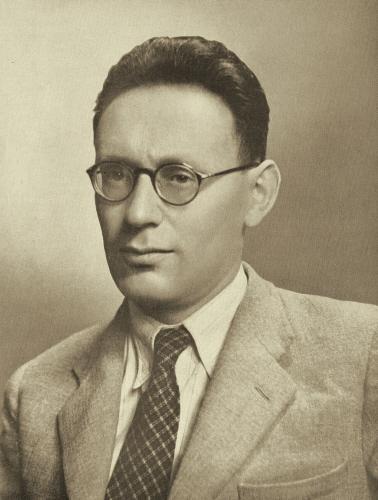 Mikhail Botvinnik.
Botvinnik worked as an engineer during the war. He was also rejected from fighting at the front due to bad eyesight. He got given three days a week off work by Soviet Official Molotov so he could study chess. Botvinnik was anointed the "Soviet Superman" due to his dominance. His record was all first places.
This "Iron Man" had a piercing mind. He was always aware of potential plots and intrigues against him. Ways in which people could benefit themselves at his expense, what people really wanted. He had a sarcastic way of looking at the world which was witty and amusing as relayed by his autobiography. He was a strong character who took clear decisive actions. He was also stubborn and would not change his iron clad perspective.
In 1943 the Moscow Championship took place. There were sirens going off but the tournament was held to put on a show of strength. The Chairman of the all-Union Chess Section Boris Veinstein invited Botvinnik to dinner. They ate cutlets, which Botvinnik says was a high quality meal in comparison to what was the norm in the wartime condition. Veinstein told Botvinnik that Alekhine was an enemy and he shouldn't play him but denounce him, and demand that he be stripped of the World Championship title and be excluded from chess totally. This is because Alekhine was seen as a Nazi collaborator. Botvinnik refused this. Botvinnik said that a lot of the opposition to him playing against Alekhine came from the feeling of other Soviet masters who were jealous of him.
Botvinnik: Weinstein was a dreadful man, simply dreadful. He hated me, and he did not want me to become World Champion. When my match with Alekhine was being discussed he used his position as head of the financial planning department of the KGB, despite Stalin's decision. He used all his connections to hinder my discussions with Alekhine. During the war he campaigned for Alekhine to be declared a criminal and for him to be deprived of his title of World Champion. He put pressure on me to be the initiator of this. Clearly this was the simplest, that Alekhine would altogether not play the match.
Russian Silhouettes, 3rd Ed., p.39
Boris Veinstein was a powerful man, the Director of the Department of Economics in the NVKD, the secret police organization which specialized in making people disappear. He worked under Beria, the head of the NVKD.
Veinstein was a lifelong friend of Bronstein and let Bronstein stay in his apartment in Moscow. He also helped allow Bronstein to have access to international tournaments abroad. Bronstein joined the Dynamo Sports Club, of which Veinstein was the Chairman.
Boleslavskaya: Later, his ill-wishers blamed him for this from time to time but, except for being a formal member of Dynamo and receiving some official references when requested by the Soviet Sports Committee to obtain a passport to go abroad, he never benefited from this membership. He entered this society at the lowest rank in 1945 and left in 1984 without promotion for almost 40 years.
The Sorcerer's Apprentice, p.21
First Meeting - 1944
Bronstein was invited to the 1944 USSR Championship. He played against Botvinnik. Bronstein came from the Kiev Chess School. He was influenced greatly by the games of the top Ukranian amateur player Dr Fedor Parfenovich Bohatirchuk who had a dynamic and tactical style of playing. Bronstein said that Bohatirchuk convinced him of the power of the Spanish Opening and the King's Indian Defense. Bohatirchuk had also beaten the classically styled Botvinnik three times.
Botvinnik won the tournament overall.
In the same year, Bronstein's father was released from the labour camp:
Boleslavskaya: In the spring of 1944 Devik's father suddenly reappeared in Moscow from the camps, suffering, exhausted and sick. He had been released due to bad health. Devik now felt it was his humanitarian duty to help his parents, both helpless, lost in society. They became his main source of worry, almost like his children. Devik, not having seen his father for more than seven years, was glad to see him alive and wanted to help him in anyway he could, trying to make him forget the ordeal he went through.
It was forbidden for his parents to live within 100 kilometres of Moscow or Kiev. Devik found a place for them to live one hour by road outside the capital, while he himself wandered from one furnished room to another, occasionally also residing in simple hotel rooms in the city. During those years he nevertheless managed to become a star in the world of chess and his name became more and more famous.
The Sorcerer's Apprentice, p.21
In the 1945 all-Union Chess Section meeting, the chess officials and the players met up. Veinstein said to Botvinnik "I don't understand how you will shake Alekhine's hand, covered in the blood of Auschwitz and Maidanek". Botvinnik's friend Ragozin prepared a letter to Stalin to get Botvinnik permission to play against Alekhine. Ragozin wanted the other Soviet players to sign the letter. Bronstein refused.
Boris Averbakh stated that Botvinnik "made every effort to get Vainstein discharged from his position". Botvinnik says in his autobiography that the question of Veinstein's resignation "came up" at the meeting. Veinstein was "desperately defending himself". Then Vassily Smyslov roasted him by addressing him as "The Former Chairman", to which Veinstein resigned.
Alekhine died in 1946, and the chess world was left without a Champion. After a dysfunctional organization, a match-tournament was finally held featuring some of the world's top players. Botvinnik won this tournament, becoming World Champion in 1948. Afterwards he took a hiatus, working as a technical engineer and focusing on his dissertation.
Botvinnik: My domestic situation was difficult. My mother had been ill for a long time. My wife had fallen ill after the 1948 match-tournament, not being able to get over all the stress and strain, and my daughter's health was not too good. I had also got fed up of trailing round rest homes when preparing for events - almost everyone of the holiday-makers considered it his duty to talk to me about chess and give useful advice. So I decided to build a dacha!
Achieving The Aim, p.126
Bronstein was a rising figure in the chess world. He placed third in the 1945 USSR Championship, signalling his position as one of the strongest Soviet players. He tied for first in both the 1948 and 1949 USSR Championships.
Bronstein said that the awarding of his Grandmaster title was unjustly delayed and that he was not included on the original list of Soviets who would play in the next Interzonal:
Bronstein: It was apparent that someone with power in the high echelon of bureaucrats liked neither my character nor my style of play.
The Sorcerer's Apprentice, p.88
Bronstein won the 1948 Saltsjöbaden Interzonal, qualifying him to the Candidates Tournament. He led the tournament, but was outpaced by his friend Boleslavsky. They discussed the idea of Boleslavsky deliberately not winning games to allow Bronstein to catch up. This is because Boleslavsky said he couldn't beat Botvinnik: "We'll all lose to Botvinnik!" . (He lost 7 games to Botvinnik in the past). Bronstein replied, "No, I can play him.". Boleslavsky talked to Veinstein who planned to put the idea of a three-person tournament between Botvinnik, Bronstein and Boleslavsky in place. Boleslavsky then deliberately drew both his games to allow Bronstein to catch up by winning both his games. Bronstein revealed this in his 1995 book The Sorcerer's Apprentice.
The three man tournament idea didn't come to fruition.
Bronstein and Boleslavsky sparred in a play off match which Bronstein won 7½-6½. A student of Boleslavsky claimed that Boleslavsky told him that this match was prearranged to let Bronstein win, with a novelty being used in one of the games to make it look realistic. This was reported in Genna Sosonko's book on Bronstein.
Botvinnik had earlier drafted the plan for the World Championship. It would be 24 games. The winner is the one who scores the most points. If it is a tie, then the Champion retains the title. This was accepted at the 1949 FIDE Congress.
Wanting to find more material on the latest chess developments to prepare for the match, Botvinnik talked to Chairman Apollonov of the Physkultura Institute to borrow the recent chess literature from the library. Apollonov asked Botvinnik if he had studied the literature last time. Botvinnik said yes, and then Appolonov replied "Then, why do you need to study it again?". Botvinnik said he was "struck dumb with amazement" at this comment. He stated that Apollonov was part of the Dynamo Sports Club like Bronstein, and so tried to hinder him by not helping him get the latest chess literature, so he got the literature without Apollonov's help.
World Chess Championship - 1951
The World Championship match between Botvinnik and Bronstein was held from March 15th - May 11th at the Tchaikovsky Hall in Moscow. The arbiters were Karel Opočensky and Gideon Stahlberg. Botvinnik's seconds for the match were Slava Ragozin and Salo Flohr. Bronstein's second was Alexander Konstantinopolsky.
Commentators thought Bronstein had good chances due to his youth and dynamic style of play. He was 27 years old, while Botvinnik was 39 and had not played chess since the 1948 World Championship Tournament.
https://www.youtube.com/watch?v=jmU24pWDm_w
The first four games were draws, "not without adventures" as Botvinnik put it.
Botvinnik's nephew later published Botvinnik's notes in his book "Botvinnik-Bronstein, Moscow 1951". These are provided by the chessgames.com user Resignation_Trap. Before the third game Botivnnik analyzed Bronstein:
Botvinnik: So far I have discovered, or more correctly, confirmed the following deficiencies in Bronstein's play:
1. weak play in time trouble - without outright blunders (with simplification);
2. weak play in technical positions without the initiative;
3. unjustified avoidance of positions without counterplay, even at the cost of a pawn.I have been unable to exploit the first deficiency, since I myself have been hopelessly short of time.
I have not exploited the second deficiency on account of poor analysis, time trouble and stupid haste - instead of accumulating advantages.
The third deficiency - I wrongly believed him, and he deceived me.
Hence the conclusions:1. the main thing - time;
2. continue to play by technique (in superior positions);
3. continue without fear - simply play chess and remember that the opponent may and should go wrong. Let's go!
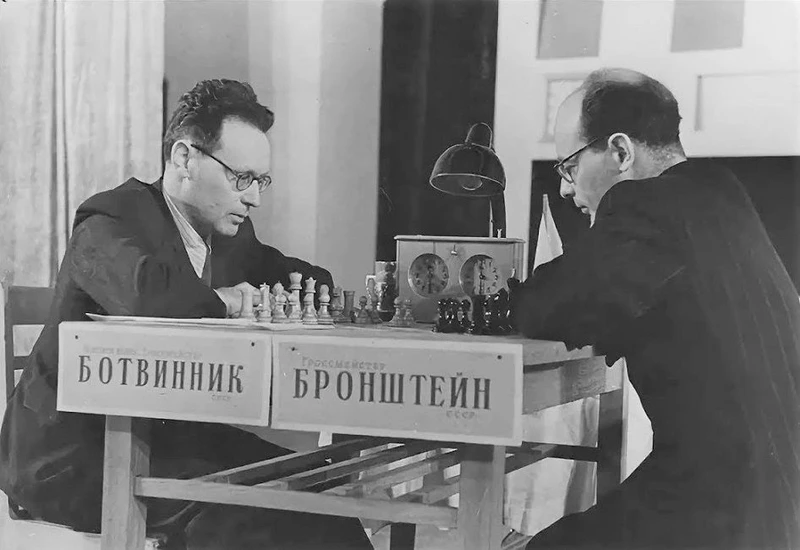
Before the fifth game Botvinnik wrote:
Botvinnik: The main things:
- time;
- aim for technique - in a superior position(?);
- calculate without fear - he is bound to go wrong (isn't he rather weak as a tactician?).
Endeavour by the 30th move to have a half hour advantage and to stir up trouble in a superior position. Let's go!
Game 5: Botvinnik overlooks Bronstein's Kh8 which makes it more difficult for him to recover a pawn. Then the e3 square causes troubles.
This was the first strike in the match. Bronstein now leads by a point.
Botvinnik: It all turned out the other way round. But, in general, it all turned out correctly, apart from time, strength and the result. It was he who won - with an attack on the king.
Flohr 1935 + Romanovsky?.
Game 6: Reached an endgame where Botvinnik had a passed d-pawn. Bronstein had a knight that needed to hop down the board to stop the promotion. He thought for 45 minutes and then moved the King. It was game over after Botvinnik's King counter-intuitively stepped away from the pawn.
Genna Sosonsko reported what Bronstein said about the blunder in his book "The Rise and Fall of David Bronstein":
Bronstein: That monstrous blunder that I made in game six, just one move. It was all very simple. Before the second session, during my morning walk, I happened to bump into my wife, Olga, whom I had divorced for all practical purposes. One thing led to another, we started to quarrel, and continued for nearly an hour. Yet, at the same time, my seconds were demanding that I play to win. So I went to the resumption of that ill-fated game feeling mentally drained.
Botvinnik: Played indifferently, missed Bc6 - then played decently.
Again time trouble and made a mess of things. On the resumption again became rattled!
Nevertheless 'Br' is stereotyped, although crafty, like Romanovsky.
The match is balanced again.
Botvinnik: Must, at last, play a decent game. Time! But in general don't hurry (25-30 moves!).
Let's go!
During the two rest days before the game, Botvinnik stayed at his dacha. When it was time to leave, the ice was on the move on the river. Which meant Botvinnik was worried he wasn't going to able to get to the game. But an obstruction blocked the ice so he could cross the river. He said that the fresh air did him some good and put him in a clear mind for this game.
Game 7: Botvinnik builds up the advantage gained from his e5 outpost. A knight endgame commences:
Botvinnik: Played, in general, passively, and also blundered (Rxc2?). For the moment rather weak. And analyzed disjointedly. Don't listen to the seconds during analysis.
Botvinnik leads the match once more.
Botvinnik: Time! You must, finally, play decently! Work!
Preserve your strength! Don't simplify to no purpose and don't lay yourself open! Pressure to move 25-30! Without counterplay! Let's go!
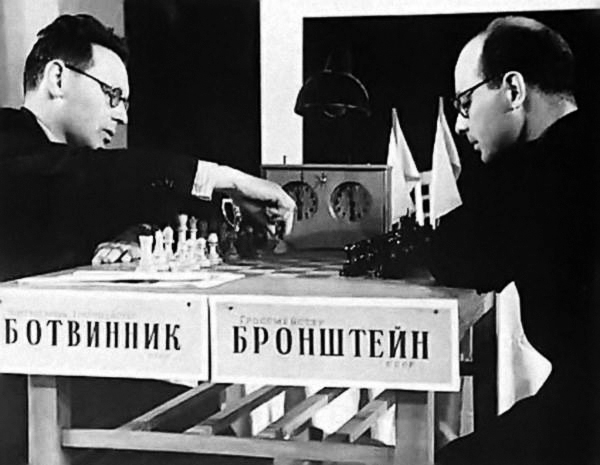
Game 9: Bronstein blunders a Rook in the opening. Botvinnik fails to convert. There is drama regarding the sealed move. Bronstein and Botvinnik think that the other player should seal. Back then after 5 hours of play, the game would be paused with one player writing the move they will make without the opponent knowing. This is done to balance what the players know while they analyze the adjourned position before resuming play the next day.
Botvinnik: Played abominably: poor preparation (like an idiot avoided the French) spent heaps of time and with every move played more superficially. By chance he fell into a trap - after which I played like an imbecile - you must not simplify in a winning position!!! - If you do, it's a draw. A nightmare!
Botvinnik: In the ninth game there was an unpleasant dispute. After White's forty-first move Bronstein was engrossed in thought, and did not notice the arbiter K. Opočensky (Czechoslovakia) coming up to the board. Bronstein noticed the judge only after the request,"Please seal your move". This was awkward for my opponent, since he tried to get me to seal throughout the whole match. His calculation was clear: Botvinnik, lacking practice, and tired out after five hours' play, would take a long time over the sealed move, and would probably seal a bad one. Then he would have an agonising night of analysis and would have little time left before the next time control.
From the practical point of view this looks sensible, but every 'rule' has to have its exceptions!
Bronstein made out that he had not heard the arbiter and made his forty-first move on the board.
According to the rules this was a so-called 'open sealed move' and there was now nothing to be written down, but Bronstein made a scene of it, and demanded that White should now seal. Opočensky was distraught, and could not make his mind up. There were shouts of 'Shame!' from the audience addressed at me (obviously from colleagues of my opponent from the some sports society; and to be honest, as always the sympathies of the audience were on the side of the younger man).
The matter was resolved after the intervention of G. Stahlberg (deputy arbiter). He reminded Opocensky of the rules, and the latter realised that his hesistation was out of place
Achieving The Aim, p.131
------
Fürstenberg : David Bronstein's version of events is quite different. From around move 30 both players were in great time-trouble. They had some idea how many moves had been made but were not sure. Although he had reached 40 moves, Botvinnik nevertheless made his 41st. At this moment both players had about one minute left on their clocks.
Bronstein had heard Opocensky's request but the session playing time of five hours for the first 40 moves had not yet been reached and he was therefore within his rights to make another move. Opocensky then realised that he should not have asked David to seal a move at that moment. He waited until the five hours were used up and then politely asked Botvinnik to seal a move. Botvinnik refused: 'You should declare his move open,' and left the playing hall. The audience shouted 'shame' and whistled but Botvinnik ignored them.
The Sorcerer's Apprentice, p.11
Botvinnik retains his one point lead, which could've been two if he had converted this clearly winning game.
Botvinnik:
- <time,>
- deep calculation and technique,
- malice and composure,
- prolong!
Let's go! A good win is needed!
Bronstein: In this game I adopted the strategy of deliberately making moves that defy all logic. This had the effect of completely confusing Botvinnik. After the opening he was psychologically 'groggy'.
---
Although the first 27 moves were played slowly, the next 13 moves, until the time control, were rattled off at high speed since both players were in time trouble.The Sorcerer's Apprentice, p.44
Game 11: Botvinnik sacrifices 2 pawns for an attack. Bronstein counterattacks with his bishop pair and turns the game around.
Botvinnik: It all turned out the wrong way round.
Stopped controlling myself and surrendered to the position. Meanwhile, must always remember the assessment of him.
The match is even once more.
Botvinnik:
- Remember the assessment, fight for an enduring initiative, harassing moves, technique.
- Work and don't miscalculate.
- Complete composure - <time>!!
Make a move when everything is clear! Let's go!
Game 12: Bronstein's pieces never get going. Botvinnik mobilises his Queenside pawns for the attack.
Botvinnik: It all turned out as was needed - because he helped!
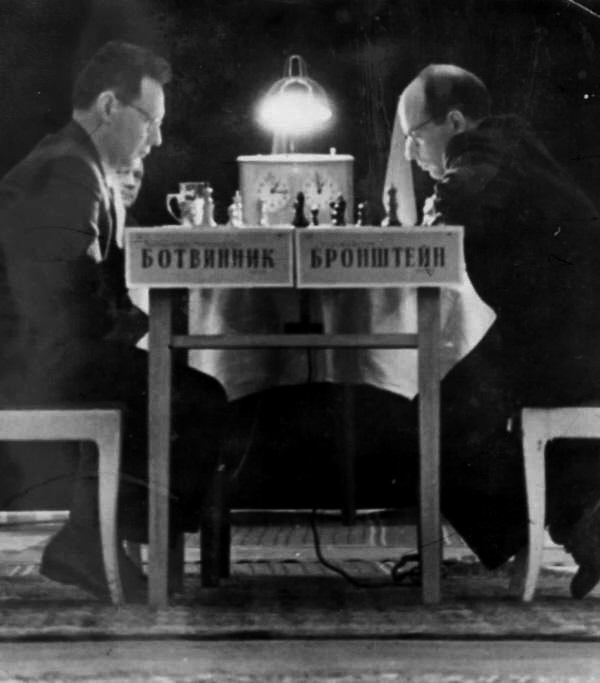 -------
Halfway through the match, Botvinnik leads 6½-5½.
During the match, Bronstein's parents were in the audience. His father was not allowed to be within a 40km radius of Moscow or live in a 100 km radius. But he watched the match in person in Moscow. Bronstein kept looking back at his father to make sure he was alright.
Bronstein: We had permission for time-out only for serious illness, because every day cost the organizers 19,000 rubles to rent Tchaikovsky Hall. During the first session Botvinnik had resigned four times, but after adjournment I had lost twice. There were no interviews—it was another era. No chance to tell the press that in the sixth row were sitting my parents and watching every move, making me nervous. Botvinnik said later that I was looking into the audience seeking moves!
By law, my father was obliged to live 100 kilometers outside of Moscow, and stay 40 kilometers away. He was violating the law. But I cannot say that my father has no right to sit in the hall! He was not yet a "former enemy of the people." He had a forged internal passport without the "prisoner" stamp. He lost it on my advice. I was happy but nervous. I was just a country boy, facing a national hero.
Andrew Solitis Interview
----
Botvinnik wrote before Game 17:
Botvinnik: There is no other way - than to play well.
Try to force him to think in the opening.
Work with cunning, watch for threats. In so doing the main thing is time. Let's go! Things need to be finished off.
Game 17: Bronstein triples on the e-file and then breaksthrough with f4 to open his pieces.
Botvinnik: Up to move 25 played well; then - lost my head.
Bronstein now equalizes the match.
Botvinnik: Work and work!
Have I really become weaker?
Let's go! Shame!
Game 19: Botvinnik has the bishop pair and a passed pawn. Bronstein blunders a draw and then the game.
Botvinnik: Played badly, but he lost his sense of danger.
The match is now in Botvinnik's favour again by a point.
Botvinnik: Endeavour! With the hope...
Let's go! After all, it is rather shameful to play badly!
Game 21: Bronstein successfully pushes b5 in the King's Indian and then attacks Botvinnik's b-pawn weakness, and then his King.
Botvinnik: Played the first 12 moves decently, but then - lost my head. More will-power! Do not waste time in vain, and when you stir up trouble - find an active plan.
With three games left, the match is still tied.
Botvinnik: More pressure, activity and clarity!
Let's go. Composure and pressure - 'The motherland is in danger!
Game 22: A Dutch opening turns into a static position. Bronstein doubles rooks on the a-file, hops his knight to e5 and then unleashes a sparking pawn sacrifice g4...
 Photo: William Winter and R.G. Wade. The World Chess Championship: 1951 Botvinnik v Bronstein. Provided by Edward Winter.
Bronstein: Two minutes after Botvinnik's resignation in the 22nd game an unknown man was on stage, tapped me on the shoulder and said "let's go." We went to the lobby, and I saw Mr. & Mrs. Abakumov! He was the head of the KGB who had feted me after my victory at Budapest. He said, "Congrats" and introduced me to his wife. While talking to the minister I could see my parents through the back of my head! I was afraid that if I won the match, my dad could get in trouble, because my private life would be scrutinized. I played the last two games nervously.
Andrew Solitis Interview
Bronstein takes the lead. Botvinnik didn't write anything in his notebook. The next game is a must win for Botvinnik.
Fürstenberg: The next morning David went, as had been his routine for every day of the match, for a walk with Lydia Bogdanova, whom he had met some time before through a wonderful trick. He had bought two tickets to the Bolshoi theatre, and on the evening of the performance, which was always sold out, he searched amongst the people who had no tickets but wanted to go until he found a beautiful girl to go with him. He fell in love almost instantly!
During their walk he indicated to her that it seemed that he was now very close to becoming the next World Champion. Would she like that? He was completely unnerved by her answer: 'I really don't care.' It shocked him and in that state of mind he came to play the 23rd game.
The Sorcerer's Apprentice, p.265
Game 23: Bronstein plays for a draw which would secure the Championship practically as he would have the White pieces in the next game. He gives up the bishop pair to simplify the position. Botvinnik tries to turn his bishop pair into a favourable endgame. Bronstein wins a pawn, and his supporters in the audience cheer...
Botvinnik: Now if I did not win the twenty-third game with White then the loss of the match seemed certain. Yet this game developed not too well for White. The crisis came after White's thirty-fifth move. I had about three minutes left on the clock, Bronstein had about ten minutes. Black could win a pawn, but he would be left with two knights against two bishops (risky in the endgame!). Bronstein looked at me, at the clock, at the audience and... went for the win of the pawn! In the hall applause broke out at once; this happened every time when Bronstein sacrified anything or won anything. On this occasion my opponent realised from my joyful face that he had gone wrong. He waved his hand at the audience, the hand- claps died away, but it was too late. On my forty-second move which I was to seal I had a winning possibility.
I thought for about twenty minutes and sealed a weaker move... Only at 8 a.m. the next day was a hidden possibility discovered (I even started with palpitations due to the emotional stress) and hope of victory appeared. Once again in the endgame Bronstein was not at his best. After 15 moves of the adjournment session his pieces had fallen into a Zugzwang position and Black resigned.
Achieving The Aim, p.132
After Botvinnik sealed his move he told Flohr to analyze with his wife, who didn't know chess. Flohr didn't know why. Before the game, Botvinnik told Flohr that he actually sealed a different move to the one he told him.
The implied reason was the possibility that Flohr could tell someone the analysis. Flohr and Botvinnik were friends, but Botvinnik didn't want the possibility of anything going wrong.
Flohr had "tears in eyes". Because he was Botvinnik's life long friend, but Botvinnik didn't 100% trust him.
With one more game to go, Bronstein must win this game as a draw will allow Botvinnik to retain his title.
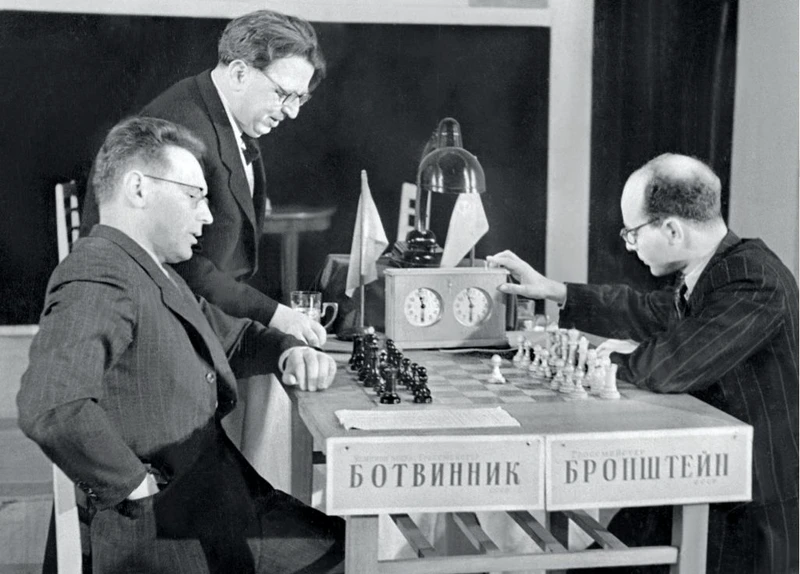
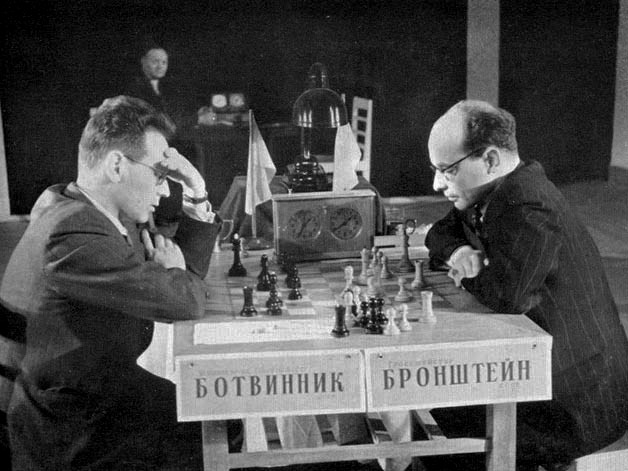 Game 24. Position after the last move of the match 22.Qxe3.
By drawing the game, Botvinnik has retained his title and remains World Champion. Bronstein said that he was worried about his father and the obligation to the Soviet state that he would have to act out if he won the title.
Bronstein: I was afraid that if I won the match, my dad could get in trouble, because my private life would be scrutinized.
----
The match ended tied. I was so happy that Mikhail Moiseyevich retained his title and I remained out of the limelight! I understood that I am the winner—without the radical changes in my life that the title would have brought.Andrew Solitis Interview
Bronstein: I had reasons not to become the World Champion as in those times such a title meant that you were entering an official world of chess bureaucracy with many formal obligations. Such a position is not compatible with my character. Since my childhood I have enjoyed freedom and despite the country that I grew up in, I have tried to live all my years in this spirit and I am very happy that today I feel the same and enjoy my freedom.
-----
Bronstein: When the 24th game was finished, many journalists came to the stage and asked Botvinnik to hold a press conference. The Champion agreed but 'forgot' to invite me to attend also. It so happened that neither before, during or after the match did the press ask me a single question about this contest!The Sorcerer's Apprentice, p.16-17
------
Botvinnik shared his thoughts on the match:
Chess Review, Sep, 1951: With all due, sporting credit to his adversary, Botvinnik praised Bronstein's play. He stated particularly that Bronstein "presses the attack with remarkable power, he has an excellent command of openings and is frequently able to wrest the initiative from the start.. Bronstein plays less successfully in the endgame and patently has to improve in this respect...."
He adds: "I have to admit that the match revealed a number of faults in my own play. Likely this happened because I had not played for a considerable time and, as is well known, practical testing of chess variations is a must for a successful performance. With the experience gained from this match, I shall go on working at chess and hope to evince good form at tournaments to come."
1951 - 1967
Their next game after the World Championship was played in the 1951 USSR Championship.
Keres won the Championship. Botvinnik placed fifth and Bronstein seventh.
After the match Botvinnik's results were subpar. He shared fourth at the 1952 Budapest tournament.
Botvinnik: There were a number of interesting games, but from the practical point of view my sporting form left a lot to be desired.
Achieving The Aim, p.135
There was some drama during the Olympiad preparations. This was the first time the Soviet team was to play in the Olympiad and the officials wanted the team to win, and for top board to get the gold medal. Botvinnik was playing training matches against the other members. He won a game against Bronstein:
During the second game between Botvinnik and Bronstein, they team was told they had to go to Sport Commitee in Moscow. So they agreed to a draw after 24 moves. Keres was called up first to the room. Then Botvinnik was called up and the officials asked if he could guarantee a win. Botvinnik said that he then realized that Keres had guaranteed that he could win the gold medal.
Botvinnik: "Ask Keres to come in, please," I requested. It had become clear to me that Keres had just given such a guarantee in the event of replacing me. After some confusion in the room it was decided to ask Keres back in. He appeared pale and embarassed. I realised then that after this 'confrontation of witnesses' Keres would not be able to play well in Helsinki- he is psychologically unstable. Playing is not the same thing as giving guarantees!
Achieving The Aim, p.136
Botvinnik wrote about how Bronstein supported Keres on first board:
Botvinnik: Bronstein said that if Botvinnik were to lose a pawn he would lose the game, but that if Keres lost a pawn he would somehow or other get a draw (a wise thought!).
Achieving The Aim, p.137
Keres said that Botvinnik is in poor form. Smyslov and Kotov said that Botvinnik should not be in the team.
Then the matter of the board placing was voted on by team:
Bronstein: First, we voted for the team line-up, and we placed Botvinnik second, after Keres. I was placed fourth. Botvinnik protested, and declined to take part. Why didn't he protest that I was placed fourth?
Andrew Solitis Interview
So the Olympiad went ahead without Botvinnik. Their next battle was in the 1952 USSR Championship. Botvinnik wanted to win as he knew people did not think he was strong. He accomplished this goal and beat Bronstein along the way.
Bronstein's father died in 1952 due to bad health caused by the forced labour. In 1953 Bronstein came close to winning the Candidates. But the shadow enveloped him once more as Bronstein recalled that the Soviet officials doubled crossed him by telling him that Geller would take a dive - which Bronstein refused to accept, while simultaneously claiming to Geller that Bronstein demanded that he [Geller] lose to him. Then they forced him to make a draw with Smyslov to secure the win for Smyslov. This was a painful time.
Botvinnik played in the 1954 Olympiad on first board. Bronstein played on third board. Their team won the Olympiad with Botvinnik and Keres receiving medals for best performance on their boards.
 1954 Amsterdam Olympiad. Back: Kotov, Smyslov, Keres. Front: Bronstein and Botvinnik. Bilsen, Joop van / Anefo. Dutch National Archives.
Their next game was a 19 move draw at the 1956 Alekhine Memorial. They did not play again for 10 years until the Moscow Team Championship in 1966 and 1967. Both games were draws. That was the last time they played over the board.
Botvinnik did not play in much tournaments between his subsequent World Championship matches. Botvinnik's proposed rematch clause that meant if he lost then he would be entitled to a rematch. The FIDE Congress had supported this. Botvinnik retained his title in a match against Smyslov in 1954, and then lost the title to Smyslov in 1957. He regained the title again in the 1958 rematch. Then he lost the title to Tal in 1960, and got it back in a rematch in 1961. Finally he lost to Petrosian in 1963. That was when FIDE removed the rematch ability.
Bronstein had something to say about Botvinnik's reign:
Bronstein: When Mikhail Botvinnik lost his title for the third time he should have played in the Candidates' Tournament in 1965 but rejected this proposition as unfair to him, claiming that he should have the right to play the 'traditional' revenge match with Petrosian as he had against Smyslov and Tal after having lost the title in their first encounters. It seems that he had created the qualifying system for others, not for himself!
Botvinnik was not ashamed at all of the fact that from the five official matches he played as defending World Champion, he did not win a single one of them but managed only two draws...
The Sorcerer's Apprentice, p.17
Botvinnik retired from chess in 1970 to work on creating chess engines and engineering. When the anti-Korchnoi petition was being passed around both Botvinnik and Bronstein refused to sign. Botvinnik got out of it by claiming he was going to make his own letter. Bronstein however had previously helped Korchoi as a second. He was kept out of Western events for 14 years. Bronstein continued playing till his death in 2006, playing in many Western tournaments after the Soviet Union collapsed. Botvinnik died in 1995.
Epilogue
Bronstein was worried about his father and what might happen to him if he won the championship. His father may have been scrutinized.
Bronstein: If I beat Botvinnik, I'd be drinking champagne, my life could be much better, but my father could go back behind bars.
Andrew Solitis Interview
Bronstein said he did not want to deal with the chess bureaucracy and formal obligations. He would have to be cordial and diplomatic with the regime who imprisoned his father.
Boleslavskaya: World Champion was an official position in Soviet society and the personality of the champion had to be in harmony with this title. However, Devik's personality and character had hardly any of the attributes that would meet these criteria. Nomina sunt odiosa - we will not cite any names but it is difficult to imagine Devik, signing a very flattering telegram to the Ruler of the Communist party or even worse, embracing and kissing him!
The Sorcerer's Apprentice, p.22
The year after the match, Bronstein's father died due to his bad health from being forced to do hard labour for seven years. Then his chance at winning the 1953 Candidates was marred by the Soviet collusion - he said this was "a splinter in my heart" . He recalls he was slowly deprived of tournament opportunities by Soviet officials. Finally he was barred from Western events for 14 years after the Korchnoi petition. This was a dark shadow that caused him great pain and resentment.
Bronstein said "a lot of nonsense" was written about how he was forced to lose. He stated "there was no direct pressure". It was the factors above which left him in a state of uncertainty. His wife said "I know how much he was hurt, not because he regretted that he never became World Champion but because of the attitude of the people close to him. The truth is that Devik was afraid to be proclaimed the official World Champion!"
Bronstein: There was no direct pressure, naturally. But there were circumstances, like my father, a manifesto opposed to the regime, who had spent several years in prison, my status as a Jew, the marked institutional preference for Botvinnik, who was seen as a Soviet model of champion... There was the psychological pressure of the environment, and it seemed to me that winning could seriously harm me, which does not mean that I deliberately lost...
Antonio Gude Interview, p.38-42, Revista Internacional de Ajedre, March 1993
The pain of no resolution creates psychological tension. He knew that winning the title would lead to undesirable consequences, but he still wanted to win. He rationalized it by viewing it as a tied match, and that Botvinnik was not clearly the best player. He thought that Botvinnik's lack of chess was due to him wanting to hide his opening prepation and deprive him of the chance of studying his games. Bronstein said that Botvinnik studied his games very well. Bronstein spoke about Botvinnik a lot. He said that Botvinnik "killed Soviet chess" by introducing a research based approach to the game. He said that Botvinnik looked at "his opponents with such hatred!".
The fact that Botvinnik was involved at the focal point of his career meant that he was on Bronstein's mind a lot. Talking about Botvinnik was a way of trying to vent resentment about what happened to him in his life. When Bronstein wrote about his Grandmaster title being delayed and being left off the Interzonal list, his co-author Tom Fürstenberg added a note: "It seems to me that this 'bureaucrat', already at that time, thought that young Bronstein would pose a threat to him. T.F". This sounds like a veiled reference to Botvinnik.
Bronstein said he did not like the concept of a World Champion. He preferred a world where chess players lived in harmony without competing and focused on the art of the game. He dreamed of an organization that would fulfill this vision called 'Green Chess'. This was clearly the yin to his life's unfullfilled yang.
Botvinnik is generally viewed as a blob, a faceless representative of the Soviet system. Some people have said that Botvinnik didn't win a clean title. Botvinnik's reputation has been somewhat villainized by this false belief. But he was just a guy trying to become World Champion, hyping himself up by writing "Let's go!" in his notebook.
Botvinnik stated that he did not like Bronstein's behaviour during the match. He didn't believe Bronstein's explanation about his father, saying that Veinstein cooked it up as an excuse. Botvinnik would never give away his win. Veinstein was an enemy of Botvinnik as he pressured him not to play against Alekhine. Veinstein being a supporter of Bronstein also meant that this rivalry was already well on its way from the beginning. Veinstein saw the opportunity of getting revenge on Botvinnik who helped boot him out as Chairman of the all-Union Chess Section. He was no doubt glad about the idea of trying to arrange a three-man tournament between Bronstein, Boleslavsky and Botvinnik as Botvinnik has less of a chance at being Champion if he has to play two people rather than one.
Botvinnik: The first with whom I severed all contact was Bronstein, after our match - he behaved outrageously. In the auditorium, directly opposite the stage, was the box of the KGB, where all his supporters from his Dinamo club were sitting. So when he sacrificed something or won a pawn, they all applauded. He would make a move and quickly go behind the stage, then he would suddenly dart out and disappear again. In the auditorium there was laughter, and this hindered my playing. And regarding the fact that he claimed that during the 23rd game he was thinking more about the fate of his father, he was prompted to say this by Weinstein, his evil genius.
Russian Silhouettes, 3rd Ed., p.39
Botvinnik had a detailed view of Bronstein's play. He thought Bronstein was good at dynamic chess and the initiative. But not strong in the endgame and technical positions where analysis is required. He said he would have lost the match to Bronstein if he would have been strong in the endgame.
Botvinnik: Bronstein was undoubtedly strong then, though his talent was marked by one-sidedness. He was good at complicated piece play, and disposed his pieces very successfully from the point of view of general considerations. As a result he was dangerous in the middle game, but when it came to accuracy of analysis when one had to look for exceptions to the rules Bronstein was not so strong. Accuracy of analysis is necessary in the endgame where a player has no right to make mistakes, just like a sapper.
If Bronstein had been strong in the endgame then I would have assuredly lost the match to him. On top of that I was favoured by the human and competitive failings of the challenger - a penchant for eccentricity, affectation and naivety in his competitive tactics.
Achieving The Aim, p.130
Botvinnik: Despite my unfortunate play the match was a blow for Bronstein, both a chess blow and a psychological one. He never managed to repeat his success.
Achieving The Aim, p.133
There are two mainstream views on the match. The first one is that some shady things were going on and Bronstein may have been forced to lose. This is false as told by Bronstein himself. There is also the view of Botvinnik as a shady person who did not deserve the title which is also false.
The second view is that Bronstein was an excuse maker with poor explanations. This is proposed by Genna Sosonko in his book 'The Rise and Fall of David Bronstein' and Andrew Solitis in his book 'Soviet Chess'. This is based on the idea that Bronstein gave 'vague' and different reasons for losing. Bronstein's reasons were not vague, they were clear. There is no doubt that he was concerned about his father as well as what his life would be like if he won.
Sources:
- Bronstein vs Botvinnik, Chessgames.com
- Chess Review, Sept 1951
- Mikhail Botvinnik, Achieving The Aim, 1981
- David Bronstein & Tom Fürstenberg, The Sorcerer's Apprentice, 1995
- Taylor Kingston, Yuri Averbakh: An Interview with History, 2002
- Dmitry Stakhov, Bronstein Interview, ogoniok.com, Translated by Roaring Pawn, 2003
- Andrew Solitis, Bronstein Interview, Chess Review, Dec 2007
- Genna Sosonko, Russian Silhouettes, 3rd Ed., 2009
- Johannes Fischer, Shattered illusions: "The Rise and Fall of David Bronstein" - Genna Sosonsko, Chessbase Article, 2017
- Lev Khariton, With Love and Bitterness, Chesscafe
- Edward Winter, Bronstein & Botvinnik Articles
You may also like
 RuyLopez1000
The 1948 World Championship
The Match Tournament. CM HGabor
How titled players lie to you
This post is a word of warning for the average club player. As the chess world is becoming increasin… IM datajunkie
You’re studying chess openings the wrong way (do this instead)
If memorising opening lines made you stronger, many club players would be masters. RuyLopez1000
Queen vs Rook Endgame.
How to Win Q vs R. RuyLopez1000
Chess Improvement is a Spinning Top geometrically speaking...
A study of 1 Billion Games on Lichess and FICS. ChessMonitor_Stats