
Amey Meher on Unsplash
He became an IM at 16. 12 years later, he became a GM.
Australia’s newest GM-elect, Rishi Sardana on what it took to make the jumpRishi Sardana became an International Master at 16. You might think he also became a grandmaster in his teens. But for Rishi, the next step took another 12 years.
In August 2026, he achieved his third and final GM norm at the Spilimbergo Master tournament in Italy and became Australia’s newest GM-elect.
Once I heard the news, I wanted to interview him and ask how he did it. GM-elect Rishi Sardana
That’s what this Part 1 (of 2) is on: the tournament where he achieved the title, how he trained to get over the line, as well as how to work on strengths vs. weaknesses and how to train consistently even as an adult working full-time.
(The interview has been lightly edited for clarity)
Firstly, congrats again on achieving the title. Let’s start with that tournament. When did you realise the title was actually within your reach?
Rishi: Super late in the tournament. I had a really bad Round 3 game, which was quite demoralising given that I was on a two or three-month long trip to Europe. I had all these hopes and dreams and then suddenly I lost and my mindset changed for that tournament. From chess-results
I didn’t realistically think I had any norm chances because it was a lower-rated player and my rating average had gone down. So I just stopped thinking about norms and treated it like a training tournament, which worked out in my favour because I stopped feeling the pressure. When you’re thinking about norms, it messes with your head and affects your decision-making.
So for the next few rounds it was just focus on the chess, keep trying to win games, reflect on my games and start to get better. Once I won my Round 7 game I had an inkling that maybe it’s possible, but again it still wasn’t realistic at that point. A friend pointed out to me: “you’ve played enough GMs, your averages climbed back up and there’s a real chance now.”
I also had a good pairing in the next round, White against Costa, who’s 2550. I felt a draw would probably not cut it, but if I go all in and I win this game, then I can re-strategise for the last round. So that was my aim. I was castled on the queenside and all my pawns were basically running towards this king. After 36.a5. The game concluded 36...b5 37.Qxb5 Rf7 38.Bxd3 exd3 39.Qb7+! 1-0

I pretty much took a Hail Mary approach in that game and once I won, then I thought “maybe I should ask the arbiter if I have a chance” and he confirmed that with a draw I get a norm. Once the pairing came out and I was Black against Dardha, who’s 2600+, it was clear that I needed a draw.
These few years, you were going for that last bit [for the title], the last norms. In this tournament, you lost early and maybe that took the pressure off you.
Exactly. It’s a blessing because I’ve had these near misses before and half the time I’m a bundle of nerves and thinking about how many points I need and calculating ahead. This time I didn’t feel the need to do all of that, so I was in some sort of flow state and it worked out.
And that last round draw got you the title. I’m interested in hearing how you felt during and after that game, how long did it take you until it really sunk in?
First of all, before the game I was a bundle of nerves because I knew what I needed. And it’s not just a question of a norm, it’s the question of the title. You make a draw, you’re a GM and your life changes.
I was second-guessing my preparation, I spent hours preparing. This was a morning round, so ideally you want to sleep early, but I couldn’t sleep. I had my laptop open, I was preparing a bunch of things. Then in the middle of the night while lying in bed, I’m not really happy with this line. I’m going back, changing my mind, I was just a complete nervous wreck.
And I probably fell asleep at 4am, 5am and I thought, “ok, we’ll see what happens the next day.” The good thing was he didn’t really need to win, he wasn’t desperate either. He was winning the tournament quite comfortably [on tiebreaks].
So the next day I go and after all of this preparation, I get surprised in the opening. He plays some weird line in the Vienna and that’s a pretty horrible start.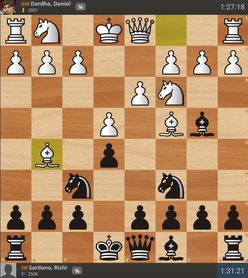
But I knew it’s not a great line, it’s not critical, so my strategy was to just play safe moves and not do anything crazy. And chess is a game with pretty high drawing tendencies. A lot of the time, if you don’t do anything stupid, you’re always within the bounds of a draw. If you just make normal moves, even if you’re not calculating like a machine, generally you’re fine.
Eventually he made a mistake and I was kind of starting to take over. It was still equal, but there was a chance that if he overextends then it’s not great for him. And the board next to us was a draw, which pretty much confirms his tournament victory if he makes a draw. He didn’t want to risk it, so we just shook hands. Draw agreed after 15...fxe4: White won the tournament and Black became a GM
Once the draw was made, I was in complete shock. I didn’t know how to process the emotions because it’s been, not even a 12-year long journey but since I’ve started chess. It’s one of the things I wanted the most in my life. I was also dog tired, so none of this felt real and I just sat at the board for two minutes with my head in my hands, wondering what the hell happened.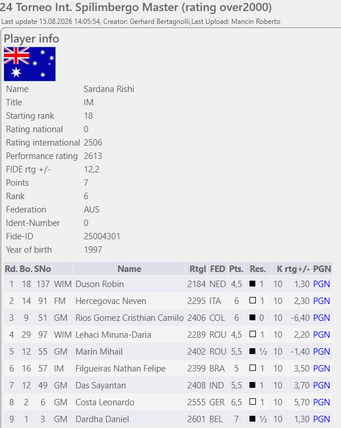
Then a bunch of people came and congratulated me and slowly I started to process what happened. Within two or three hours, once it sunk in, I called my parents and talked to a few people over the phone and then I was really happy and went to celebrate in the evening. It was one of the best days I’ve had in a long time.
It’s been a few weeks now, what changes have come in your emotions? Does it feel real now, or are you still sort of processing it?
No, I think I’ve fully processed it now. I was speaking to some GM friends of mine and they were joking about how once you become a GM, you feel amazing for a week and then you’re like, “wait, life is the same.” That’s exactly what happened. Now, life is normal.
Obviously it still feels amazing. I have to keep reminding myself that I’m now a GM, not an IM and looking back at how hard it’s been, what I’ve accomplished, it feels really good.
A lot of people in chess might think, “from IM to GM it’s just a hundred rating points.” I think you know better than anyone at the moment: what makes that jump from IM to GM so hard?
I think that 100-point jump is very personal for everyone. Some people don’t have a struggle at all, some become IM and then suddenly they’re GM the next moment. More common among youngsters obviously. Everybody I talk to has had a different struggle, and for some people it’s not even that obvious what they’re lacking.
For me, it was pretty obvious what was holding me back, why I was not making the jump. There were multiple reasons, but if I had to zero in on one, it was the amount of time I was putting in and the fact that I was trying to do everything at once. This concept of balance.
I went to uni and there I was doing a moderately difficult course, by my standards at least. It was hectic. Then I was focused on clubs, internships, things like that. I was prioritising a bunch of things at once and that continued once I entered the workforce, not out of choice but out of necessity.
Once you have a full-time job, then you have to work 8-hour, 10-hour days and you have to cook, you have to clean and everything. So that prioritisation was definitely holding me back because chess is a game that requires you to be in the zone and requires you to be consistent. Consistency gets rewarded.
It’s a virtuous cycle. If you’re working on something every day, you get better. If you’re getting better, then you continue to work on it every day and you’re more motivated and the cycle just goes on.
The problem is, I had broken out of that cycle because I was doing too many things. I wasn’t really in that mindset for chess, constantly thinking about chess, reflecting really hard on what it takes to improve and the little things about my game. So that was one factor, time and consistency.
But I still think, for an adult improver it’s not all doom and gloom. Just because you don’t have time, doesn’t mean you’re not going to make it. You can still do a lot of things. And if I had done a few things a bit better, I probably could have made it sooner.
For example, I was not very collaborative. Until the past one or one-and-a-half years, whatever work I did on chess was isolated, I did it on my own. Only in the recent past did I start to connect with people and we’d play training games, analyse openings together, try to solve each other’s problems chess-wise. If I have certain weaknesses, my friend would show me some positions, and vice versa. And it took me a long time to realise how important that is.
My friend, for example, pointed out to me that when I’m calculating, I’m trying too hard to make specific lines work. If I see a line and it looks good, I’ll spend most of my time trying to make it work and I won’t move on if I don’t see a win. I’m too persistent, and those little idiosyncrasies about your thought process, you’re not necessarily in the best position to see them when you’re training alone. When you’re training with a friend, it really helps.
Plus stylistically, if the people you’re working with are very different from you, you pick up a few things from them. We’ve played a few times over the years, you probably know me as a risk-averse and principled player. I’m playing normal openings and fairly solid. Some of the people I worked with are the exact opposite. They love to take risks and they’re very probabilistic and practical in their thinking. They will look at the engine evaluation and ignore it and say, “hey, my opponent is not going to find this, so who cares?” And that aspect of their thinking, I picked up some of it through osmosis and it really helped me.
Especially when you’re making that climb from IM to GM: no guts, no glory. You need to take some risks and you need to think about the opponent’s psychology a bit, especially when choosing your openings. So collaboration was another thing that really helped me make that jump, and that's a very common mistake people make, working alone and not talking to people.
Did you make an active effort to collaborate, or was it other people who asked you as well? How did that come about, that change?
I’ve had conversations with stronger players about what they’re doing and the common factor was that they have training partners for playing training games on a regular basis, and analysing those games. Some people I know work with six or seven different players, strong players, different from each other and they’re just getting so much information. And I realised I’m really limiting the amount of knowledge that I’m getting just being by myself.
Some of it was organic, you become friends with equally ambitious players at tournaments and they’re like, “hey, let’s connect online, let’s play some games” and it just happened with some people, but I kind of knew at the back of my mind that this thing matters and it can help. But once it started to play out, it was only then that I realised, “****, this is a gold mine, I’ve struck gold here.”
I have a question from GM Vaibhav Suri, he asked whether any friends were influential in helping you achieve the title. Who are the people who made a real difference to your journey?
Yeah, special shout-out to Vaibhav, he was one of them. He’s a childhood friend, we go way back. We grew up in the same city, we played a lot of the same tournaments together. It’s public knowledge now that he works with some of the strongest players in the world. He’s always had this insane work ethic, he’s always known how chess improvement works a lot better than I have.
I’ve talked to him a lot and taken some advice from him on how to get better at chess. We’ve roomed together at certain tournaments and just watching him in action, watching how he prepares has also been immensely useful. When you see someone playing so well who’s like an absolute superstar, just winning one tournament after the other, you pick up a thing or two. So I’d for sure say he’s one of my really close friends in chess and definitely been a really good influence on me.
Apart from that, I made a lot of really good friends in Australia, in the Aussie chess community as well. Mihajlo [IM Radovanovic] has been a huge help to me. We’re both around the same level, and he’s got I think two GM norms and he was very close to 2500. One of the stronger, more talented IMs I know. We decided to start working together and play some training games, and all of the work I’ve done with him has been really useful.
He’s also a very prominent coach in the New South Wales, Australian Capital Territory area. He has a lot of students there and he’s constantly thinking about chess improvement and how to get better. He has that mindset and spending time talking chess with him has been amazing, he’s been a big part of this. So huge shout-out to him.
In your climb from IM to GM, one factor you mentioned before is that you weren’t all-in on chess, so the time factor was one thing. But how did you work on your weaknesses, because I think you really have to, to make that final jump to GM.
100%. One of my big weaknesses was calculation. I’m not a great calculator and often, when I’m calculating, I make these glaringly obvious mistakes. If you’ve read Aagaard’s books, he often talks about certain things, they’re sinful and you should not be doing them. For example, jumping back and forth between variations without making clear conclusions. My brain was all over the place sometimes, and that lack of focus and structure in my calculation was a big issue.
Luckily calculation is one of those things you can really train. It’s a muscle and the more you do it, the better you get, and the path to fixing that was fairly straightforward. I was doing a lot of solving, going through a lot of these really challenging books and trying to solve positions. Set myself some challenges and try to not just solve the positions and finish the book, but also consciously check myself when I’m making these mistakes: going back and forth between lines, spending too much time on one line.
I didn’t have much of an opening repertoire before this. I would rely a lot on Chessable and some random courses here or there. Most of my games, I’d be trying an idea for the first time in my life. Like the game against you, I played this ...Re8 in the Nimzo, I’ve never played it before but I just decided on a whim to play it.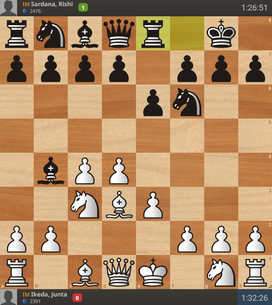
I think we both struggled a bit in that game, but the point is you can’t really be winging it when you’re trying to go from IM to GM. When you start playing young, ambitious, strong grandmasters, when you’re playing these strong opens like Spilimbergo, Abu Dhabi, you’re up against some absolute beasts.
Ideally when you play something, you shouldn’t have faced it for the first time in your life. You should have played some training games, analysed it, this should be in your laptop. You should have made your own conclusions about it. So the work I did on openings changed and I tried to form my own understanding of the positions that I was analysing, a lot of space-barring [following the top engine line] to make sure I understand the nuances of a position and I’m not just stopping at 0.00 [engine evaluation of dead equal].
The structure that I brought to my openings helped because I didn’t really have good Black openings, and now I’d like to think I’m a little more solid with Black. And with White I was not really going for a maximalist approach in the opening. I would go for plus-equal, a slight edge and keep playing.
In Australia, when you’re playing tournaments like the Doeberl Cup, double-round days are really hectic. That kind of approach works there, but it’s also immensely useful to have really concrete forcing lines where your opponent has to memorise things in order to survive. So trying to add that extra layer to my openings helped. I had very limited time so I had to apply the 80/20 rule and focus on the things that mattered the most.
In chess, we have some people who say you should work on your strengths, but so much of it is working on your weaknesses too. When someone wants to improve, how should they balance that? Should they try and get better at one area or should they focus on their weaknesses?
That’s an age-old debate that hasn’t been solved: what do you focus on, what do you not focus on? I remember someone telling me that when you’re a younger, improving player, let’s say 1700, 1800, you’re trying to climb up to FM/IM/GM level, then you should become really good at your strengths.
And once you’re trying to go from IM to GM or GM to really strong GM, then you work on your weaknesses because the players you’re playing against are going to be able to expose your weaknesses a lot more. So if you’re an attacking player, then at 1700 or 1800, just go all-in, start playing the King’s Indian and strengthen your attacking instincts, become a calculating machine, become Mikhail Tal. And then when you’re 2400 or 2500, try to bring more balance into your game because you have to be a well-rounded player when you’re stronger.
This makes complete sense to me as a philosophy, and I do abide by it. But it’s not as simple as that because when you’re 1800, you’re working on your strengths and you ignore a certain weakness, that weakness could be the thing that’s holding you back. It depends on how well you can mask that weakness and how much people are able to exploit it.
If you do find yourself losing a lot of games because of it: you’re bad at tactics and you keep blundering or you have terrible time management and you end up with one minute on the clock every game, that’s a weakness you can’t delay working on. So you have to prioritise your weaknesses and think about, “do these need to be solved in the immediate term?”
If I have lots of time then obviously I work on all aspects, I try to be balanced. But if I have a limited number of hours in the day and I have this weakness which is there but it’s not losing me games? Then I can sideline it and instead work on becoming even better at the things that I’m good at so that I can win more games there.
You’ve balanced chess and full-time work, and studies earlier in your life as well. I think that’s something everyone struggles with, because we all have different things in our life and we want to do well in all of them. How did you manage to balance all these things over the years? Techniques like the 80/20 rule, could you explain how you think of these things and execute?
First of all, unfortunately, you do have to be a bit of an addict. For something like chess you need to have some sort of obsession or addiction to make big swings and big jumps. In the past one, one-and-a-half years I was basically obsessed with chess. Outside work, my routine was around two to four hours of chess every night, and social stuff went out of the way.
I don’t encourage other people to take that approach. I think there are more balanced ways of doing things, but many of the people I know, like in the Aussie Olympiad team, they’re constantly thinking about chess and it’s definitely helped them.
Going back to an earlier point: when you’re a full-time professional or a student, a big thing you would struggle with is consistency. So if you can block a certain amount of time every day to work on chess, that’s already a big achievement, whether it’s one hour of focused calculation training or half an hour of openings, half an hour of training games.
If you have a clear idea of what you want, you’re blocking out time for targeted improvement, not just something random but something intentional. Those things are going to add up over time. Before 2025, I was working in big bursts, like working on chess a lot for two months and suddenly redline for the next two months, I’m not even opening my laptop. But doing it every day, being consistent is absolutely crucial.
Going back to the 80/20, you need to prioritise well because you can't do everything and you need to focus on the things that impact your results in the most immediate term. Having good openings, being able to win a game out of the opening is amazing. It’ll fetch you a lot of points. And calculating well. Chess is 99% calculation, it’s cliché but it’s true. You could play pretty horrible, you could have no middlegame understanding, but then you could swindle your opponent later on just with calculation and I’ve seen that happen so many times.
So when you’re working, you will need to prioritise things that matter the most and delay the other stuff for later. Those were quite important for me as an adult improver, those are the big changes I made.
That was Part 1 of the interview - in Part 2, I asked Rishi about his earlier steps in chess, reaching 1800 around age 13 and how he got to IM over the next 3-4 years, as well as his advice for improvers on how to train calculation, how to analyse, top 3 chess books he recommends and more.
(full video of interview also now out here)
If you want to take a step back and look at how you're working on chess now, what's working well and what could be improved, I wrote a free ebook, The Chess Improvement Reset. If you've been feeling stuck or want to try some guided exercises to take stock of your chess and day-to-day routine, feel free to check it out.
You may also like
 IM datajunkie
Chess players remember too much
Losing and the weight of experience in your chess IM Lizard1
He Refused To Develop a Single Piece For 17 Moves
In this game, White played 17 consecutive pawn moves before developing a single piece, which led to … IM datajunkie
You’re studying chess openings the wrong way (do this instead)
If memorising opening lines made you stronger, many club players would be masters. IM datajunkie
What most improvers are missing (a new GM explains)
Interview Part 2/2: how Rishi Sardana got from 1800 to IM, and advice for improvers IM datajunkie
Our 64 most memorable moves
Share a move you'll never forget for our community chess collection GM Avetik_ChessMood