
Small Variations in 960 starting positions I
Why starting positions that we may confound at a first glance have different evaluations?Brief introduction
In music, 'variation' is a compositive technique consisting in take a motiv and repeat it with alterations. There are many examples, Bach's Goldberg, Beethoven's Diabelli or Brahms' Haydn are masterworks.
We all know that changing the location of a humble pawn only one square in any position can change the game result or be indifferent. In 960 starting positions too? (not pawns, of course)
In chess960, I want to explore similar starting positions, but with different evaluation and difficulty.
Comparing similar positions #80 #464
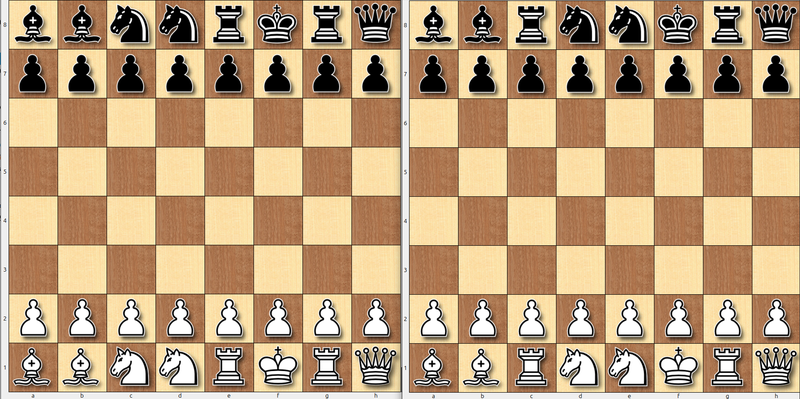
Only one rook and one knight exchange locations, but evaluations are radically different, even with the same weakness in d7-d2
In position #80 1.g4 is critical with +0.6 and demands an accurate defense to black.
We may have this astonishing variation for those who like attacks with sacrifices. Two pieces, who gives more? Final position is evaluated with a +0,7. I feel that I would lose with any side.
and #464 first suggestion is 1.b4 with an evaluation of a modest +0.2
If 1.g4 here there is this fantastic defense:
Let us see some games with these positions.
Position #80
A 37% of games begin with 1.b3, a natural move that loses all the initial advantage. The first coincidence between humans and SF is 1.g3, placed as the 4th best move by module and played by 9% of humans.
How difficult is to play #80 with black that, even being GM, evaluation is +2.2 after the 4th move without a blunder and with balanced material.
SF dislikes weakness of light great diagonal and d5 square.
A 3+3 game of your humble narrator with 1.g4 and how black center configuration is not enough. I find interesting how players face 1.g4 with different plans, not always easy to attack, but not for our sparky friend. Black must have a development plan, since the beginning. 1.g4 is annoying.
What happens with symmetric defense? Pain.
In the next 5+3 game, I missed 5.b3 ! If 5...Qa1,6.Nc3 Nd4. This last move is the reason because I did not move 5.b3, I thought that 7.Bc2 was not valid after 7...Nc2 ,8.Ra1 Na1 and I only saw two pieces and a rook for the queen. But our circuited friend gives a +5.7 after 9.hg5. White attack is very powerful. Qh6 in combination with Nc5 is stronger that I could think at first glance.
Which is the best option for black? What I found is to try the same trick of great diagonal with black.
1.g4 Nd6 , I would like to play Nc4 one day, d2 is also a a weakness. 2.b3 (no) Ne6 (trying to connect pieces as fast as possible) 3.Nd3 (be careful with Ne5 now) f6 (nop, the entusiastic and premature 3...b6 is punished with 4.Ne5 +-) , 4.c4 (giving place to my pieces), b6 (surprise!) after 5.f3 evaluation drops to +0.2. I agree that after 5.Qa8 c6, 6.c5 bc5 7 Nc5 Nc5, white does not lose queen immediately, but he lost his piece up and his position is still a ruin. -4.4 after 8.Bf5.
I already commented this position in an article edited by Stefan Loeffler in his Pocketchess 2025 as well as in the Arno Nickel's Yearbook 2025.
The most similar I found is this modules game, interesting the way to play pieces of black. 10...Bd4 was better instead the bizarre Ke8, No 10...Nd4 11.c5
Endgame, beginning in move 22, is an excellent example of how important is to have a good pawn structure.
And about #464 what happens now?
Position #464
The recommendation of SF 1.b4 is played by only 4% in human games, but we are lucky to have a 10+3 game played by two 960 lovers GM's.
39.Bf4 is a strange blunder. Both players were in time troubles. The opening is the normal answer against 1.b4, specially with both bishops in left corner, b6 followed by c5. They arrive to a symmetric structure. The variation 7.Nf3 Nf4 8.Qf5 Be4! 9.Bxe4 e6, with white's queen trapped comes from Navara's himself comments.
Many years ago catalan master Maximo Borrell, Catalonian champion in 1971, in a conversation with your humble narrator speaking about exchange variation of French defense 1.e4 e6 ,2.d4 d5, 3.ed5 ed5 , he told me that a symmetric position could be better for black because he adapts his defense against white attack copying or not. I am not agree at 100% , initiative is more important, but it doesn't mean that I don't consider his words as an intelligent observation. How beautiful is chess that 'initiative' in a symmetric position of an endgame possibly brings the defeat (opposition).
In the next game young talent Faustino Oro falls in a bad position after a non recommended castle, black plays then the plan with g5. Precisely after a symmetric position. Bortnyk comes to give reason to Borrell's words.
I don't understand distribution of question marks. The real bad white move is 5.0-0. It compromises the rest of the game but is ignored in the analysis.
A game with 1.g4 . Bishop a8 is now easily defended with rook in c8, but not with the path choosen by black player in the next game. You can see above what our energetic friend thinks about the best defense against white first move. 2...Bf4 is a super logical move, Ba8 is now defended and dark bishop will go until f6 square. A real new idea in the opening for chess960.
Before finishing this blog somebody may ask himself, what happens with rook in d1? Well, 1.g4 is still the best move according SF but not so much as in #80. No weakness in d7 and rook is nearer a8 bishop. Nevertheless difference of evaluations is not so much remarkable as between #80 and #464, that is the idea of the current blog, to find similar positions with big evaluation changes.
Position #176
Against the stronger move 1.g4 is very interesting the plan opposed by Bortnyk trying to block great diagonal. How is SF not agree and gives the alien variation that you may see in its comments. 3.b4 is done when white consider that is needed against black expansion c5.
At the end of my blog, Q=5, Patterns-in-960-starting-positions-ii I display three games of position #176 under the topic of the blog 'bishops in corner, symmetric opening b3 c4 against b6,c5' and also in first part Patterns-in-960-starting-positions-i 'bishops in corner, non-symmetric opening games' three games with 1.g4.
You may also like
 CM HGabor
How titled players lie to you
This post is a word of warning for the average club player. As the chess world is becoming increasin… thibault
How I started building Lichess
I get this question sometimes. How did you decide to make a chess server? The truth is, I didn't. IM justiniano565
Patterns in 960 starting positions I
Bishops in the same corner CyberShredder
How to improve at Chess960 ?
How many books should you read? RuyLopez1000
The Secret History of Chess Engines
"It doesn’t mean Kasparov isn’t a deep thinker, just that you can bypass deep thinking in playing ch… IM justiniano565