
The Most Effective Chess Training
In this blog you will learn about the most effective chess training.The Desire to Improve
Every chess player eventually reaches a point where simply playing games is no longer enough to keep improving. At that point, they need something more.
Although there are countless excellent books, video courses, other resources, and methods available to help you improve, it is very common for chess players to start following a particular training plan only to abandon it after a while. Sometimes responsibilities get in the way, but, more often than not, boredom is what causes them to stop. After taking a long break, they return to chess and start again, only to eventually stop once more for one reason or another.
This raises the question: What can we do to break this cycle?
My answer is to make your daily training as simple and as enjoyable as possible. The simpler your training is, the easier it will be to stick to it. And the more enjoyable it is, the more likely you are to continue doing it over a longer period of time.
What Does the Most Effective Training Consist Of?
To make our training effective, we need to focus on the two most important aspects of chess improvement.
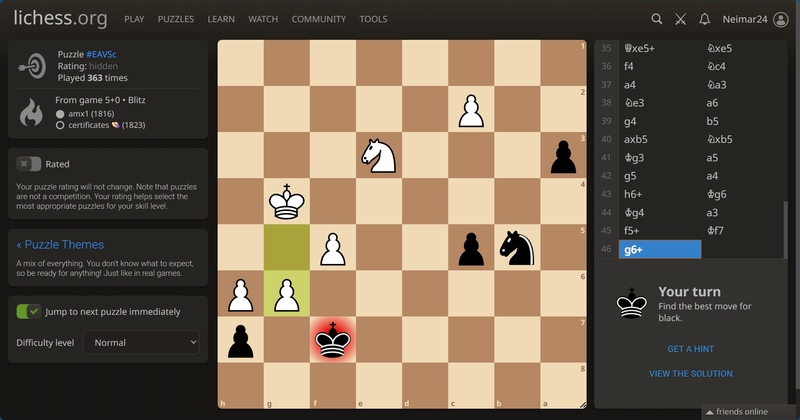
The first is tactics. Tactics occur in the opening, middlegame, and endgame, and they can be found in almost every chess game. They are also one of the most common reasons why games come to an end. Solving tactical exercises is therefore an essential part of chess training, which is why we will make it the first part of our training session. We will discuss how much time you should spend on tactics later.
Tactics, tactics, tactics!
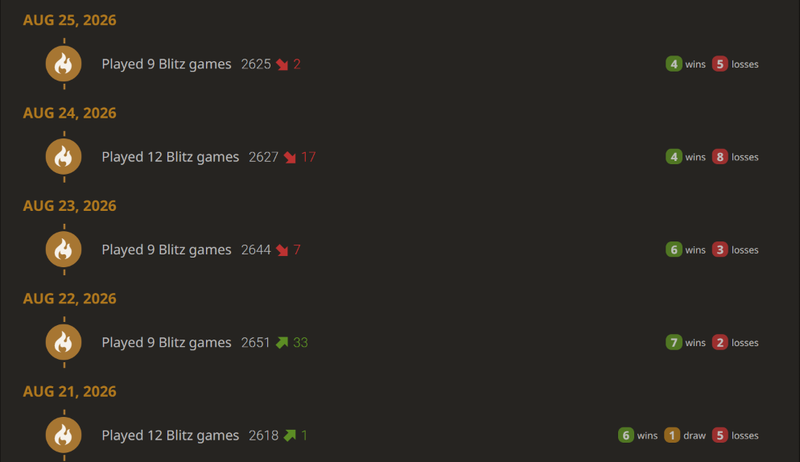
The second part of our training should be playing chess. I believe that playing is one of the best ways to improve because it allows you to go through every phase of the game. By thinking about your moves and making decisions during the game (not simply playing bullet games where your main goal is to knock your opponent off the board) you are actively working on your chess skills. On top of that, if you have been solving tactical exercises, you will immediately have opportunities to apply what you have learned in your games.
You have to play every day!
How to Organize Your Training?
Now that we have established what the most effective training consists of, we need to decide how much time to spend on it. To keep everything simple, the easiest approach is to divide your daily chess training into two equal parts.
If you want to train for one hour, spend 30 minutes solving tactics and 30 minutes playing chess. In my experience, it is particularly important to work on tactics before playing. It is very easy to get caught up in playing games and end up skipping the other part of your training altogether.
So the formula is simple: 50% of your training goes to tactics, and 50% goes to playing chess.
When it comes to tactics, I recommend solving Lichess puzzles. They are completely free, there is an almost unlimited number of puzzles available, and you can simply keep solving them one after another. Your puzzle rating also gives you a way to track your progress. As for how much time you should spend on each puzzle, there is no minimum. I would, however, set a maximum of 10 minutes. There is no need to worry too much about this, because it is perfectly natural to spend some time trying to find a move during that period.
When it comes to playing games, I recommend playing either 3+0 or 3+2. I believe that playing faster games is useful because it allows you to play as many games as possible during your training session. Analyzing your games afterwards is an excellent practice, but realistically, it can be boring, and very few people actually do it consistently. We will discuss how to analyze your games and why analysis is important in a future blog post. For our simple and effective training routine, however, all you need to do is solve tactics and play as many games as possible!
How Long Before I Can Expect Results?
In my experience, you can start seeing improvement after just one month of training this way. Tactics will help improve your tactical ability, which will have a positive impact on all three phases of the game. And since you are playing every day, you will also stay in practice and remain sharp, while actively applying everything you have worked on through tactical training!
Hello, everyone!
As I begin this exciting journey of blogging about chess, I’d appreciate your feedback on my posts. Your encouragement and constructive criticism mean a lot and help me grow as both a writer. My goal is to create content that inspires, educates, and connects with chess enthusiasts of all levels.
If you’re interested in improving your own chess skills, I also offer personalized coaching sessions! You can find more details on my profile.
Thank you for reading, and I wish you great success and joy in your own chess adventures!
You may also like
 IM Neimar24
Surprising Your Opponents with the Kupreichik Sicilian
In this post we are going to talk about one interesting variation of the Sicilian Defense. IM Neimar24
The Most Common Blunder: My Observation
In this post we are going to discuss my observation on the most common type of blunders that occur i… IM Neimar24
Chess Opening Tips: Build a Repertoire That Wins
How to build an opening repertoire that suits your style, avoids common pitfalls, and helps you win … IM Neimar24
The Kupreichik Sicilian: Part 2 - Answering the Questions
This post is a short response to comments and questions about the Kupreichik Sicilian, explaining wh… IM Neimar24
How to Speed Up and Sharpen Your Calculation During a Chess Game
The simple daily habit that separates creative players from consistent winners. IM Neimar24