
How Masters See the Board
My friend studying psychology sent me this picture from one of his books:
 At first I just thought it was funny to see a chess diagram show up in a psychology textbook. But the text around it caught my attention. At the top, it quotes the educational psychologist David Ausubel from 1968:
"The most important single factor influencing learning is what the learner already knows."
And at the bottom, the book sums it up in one line: what you know determines what you see.
I've been thinking about that sentence ever since, because I think it explains more about chess improvement than most things I've read.
Try It Yourself
Before reading any further, let's do the exercise shown in the book! Take 10 seconds and look at the position. Don't think about moves. Just look.
What do you see?
Here's my guess at what different players would say:
A beginner sees pieces. Some pawns in the middle, both kings still in the center, nobody has castled. Maybe they notice that nothing is hanging, and that's about it.
An intermediate player starts noticing details. White has pawns on d4 and e5, Black has a bishop on g7 and a knight on c6. Both sides are still developing.
What a master sees is something else entirely. They might say: This is a typical structure from the Alapin Sicilian with ...g6. The moment they look at it, a whole set of ideas shows up on its own:
- White has an advanced pawn chain on d4 and e5, which gives them a space advantage.
- Black's bishop on g7 is staring straight into the e5 pawn.
- Black's main pawn break is ...f6, challenging the chain head-on and opening up the g7 bishop.
- Black's central pawns are fixed on light squares, so Black is usually happy to trade off their light-squared bishop.
- The c-file is open, and both sides will fight over it.
- The d4-pawn cannot be protected by any other pawns, meaning Black will likely put pressure on it with the c6-knight, ...Bg4 to remove the knight on f3 that defends it, and also maybe ...Nh6-f5. Based on the same logic, White will likely try to relieve the pressure on d4 by eliminating the c6-knight with Bf1-b5-xc6, and then also support the f3-knight with Nb1-d2, so that when Black takes, White can simply recapture and still defend d4.
The Science Behind It
In the 1940s, the Dutch psychologist (and chess master) Adriaan de Groot showed chess positions to players of different strengths for just a few seconds, then asked them to reconstruct the position from memory. The masters could rebuild almost the entire board. Weaker players remembered only a handful of pieces.
You'd think that means masters simply have better memories. But in 1973, William Chase and Herbert Simon ran the experiment again with a twist: they also showed players positions where the pieces were placed randomly. Suddenly, most of the masters' advantage disappeared.
So masters don't remember more. They remember differently. Instead of seeing 25 individual pieces, they see a handful of meaningful chunks: a fianchettoed bishop, a pawn chain, a typical piece setup. Five chunks are much easier to remember than 25 pieces. Random positions don't have any chunks, so the master is back to square one, just like everyone else.
That's Ausubel's point in chess form. New information only makes sense when it has something to attach to.
Can You See the Game?
Let’s put this to the test. Here’s a position from a famous game, except there are no pieces, just squares. The Dark squares symbolize Black pieces, light squares are White pieces. Small squares are pawns, medium squares are minor pieces and rooks, and the big ones are kings and queens.
 To most people, this is just a bunch of squares. But a strong player can usually tell almost immediately what’s standing where. The small squares form a pawn structure they recognize, and once you know the structure, it’s not hard to work out which medium square is a knight, which is a bishop, and which big square is the king. Some might even recognize the exact game.
Can you? Write your guess in the comments.
Now let’s make it harder. In this next one, every square is the same size. No difference between pawns, pieces, kings, or queens. All you get is the layout.
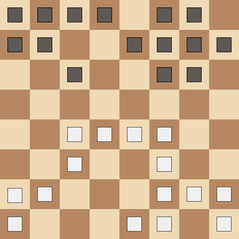
You’d think that’s impossible. But for someone who has seen enough games, the layout alone is often enough. The shape tells you the opening, the opening tells you where the pieces probably stand, and from there a master might recognize not just the position, but the exact game it’s from.
My advice is to divide the board into segments of patterns you might know. For example:
 See the board any clearer?
If you think you know the game, let me know in the comments!
What This Means for Your Chess
If what you know determines what you see, then how you study matters a lot more than how much you study. A few things follow from this:
Study structures, not just moves
Memorizing that 5.e5 is the main move teaches you one fact. Understanding what the d4/e5 chain means for both sides teaches you a pattern you'll recognize in dozens of different openings.
Connect new ideas to what you already know
When you learn something new, ask yourself where you've seen something similar before. Is this bishop bad for the same reason as the French bishop? Is this outpost like the one in your favorite opening? Every connection makes the new idea stick.
Play through master games in your own openings
This is probably the most efficient way to build the chunks the research talks about. You see the same structures over and over, with strong players showing you what to do with them.
Want to Learn a Structure Properly?
This idea is exactly how I build my own studies. Instead of a long list of moves to memorize, each one is built around a single pawn structure: the typical plans for both sides, the key squares, the standard maneuvers and pawn breaks, and practice chapters where you put the ideas to work yourself.
On my Patreon, you'll currently find two of them completely for free. The Benoni structure as Black and The Italian structure as White. New studies come every friday, so don't forget to become a member for free!
I hope you found this article useful. If so, please leave a like <3
You may also like
 TotalNoob69
The REAL value of chess pieces
... according to Stockfish thibault
How I started building Lichess
I get this question sometimes. How did you decide to make a chess server? The truth is, I didn't. FM Zig_Zag_Zug_Zwang
The Pyramid of Evaluation [Part 1]
There is nothing more important in chess than the ability to evaluate a position. Without it, you ca… GM Avetik_ChessMood
10 Things to Give Up to Enjoy Chess Fully
Discover how embracing a lighter mindset can help you enjoy chess again and achieve better results. FM Zig_Zag_Zug_Zwang
I Analyzed 100+ Games In The Italian... This Is What I Learnt:
Hi! My name is Vidar Grahn. I'm a 20-year-old FIDE Master from Sweden, and as part of my journey to … ChessMonitor_Stats