
The Pyramid of Evaluation [Part 1]
There is nothing more important in chess than the ability to evaluate a position. Without it, you can't build a plan or calculate accurately, since you won't be able to tell which of the resulting positions at the end of a calculated line is actually best. Evaluation touches almost every part of chess, even positional decision making, since your read of the position is what tells you whether to play passively, actively, or push toward simplification.
Hi! I’m Vidar Grahn, a 20 year-old FIDE Master from Sweden. This is Part 1 of a two-part article on what I call the pyramid of evaluation: a simple model for deciding what matters most when you look at a position. Here, we’ll go through the idea behind the pyramid and its base, king safety.
Evaluation is a genuinely complicated skill, one built mostly through pattern recognition and long familiarity with the game rather than any fixed formula. Even so, it can be simplified into a rough model of what gets prioritized and when. I call it the pyramid of evaluation.
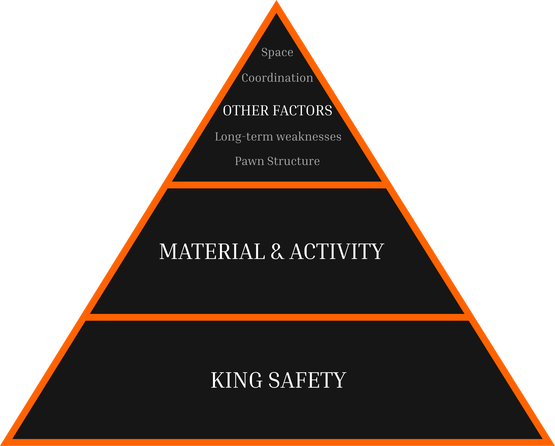
Layer 1: King Safety
At the end of the day, the goal of the game is checkmate. It doesn't matter if you're five queens up if you're getting mated.
It's tempting to treat king safety as a single, binary state: castled means safe, uncastled means unsafe. In practice it's built from several separate factors, and a king can be technically castled and still be in real danger, or still sitting in the center and be perfectly fine.
The pawns directly in front of a castled king are its first line of defense. When castled short, the f-pawn is initially defended by both rook and king so it’s generally not that big of a weakness. The g- and h-pawns on the other hand are both exclusively defended by the king. This means that with no additional protection, a sacrifice on either pawn is common, famously the Greek gift sacrifice, or even more appropriately, the double bishop sacrifice, which is when you sacrifice your pair of bishops for both h- and g-pawn to completely expose the king.
 Without any additional supporting piece, the h2- and g2-pawn can become weaknesses.
It’s also important to note that pawns can only move forward, so any hole one of them leaves behind can never close again, whether or not it's ever actually punished. Which pawn moves matters as much as whether one does. Push the h-pawn, and you've handed your opponent a potential sacrifice on that square. Push the g-pawn, and the neighboring squares, f6/f3 and h6/h3 for a kingside-castled king, are no longer covered by anything. Push the f-pawn, and the diagonal running toward your king opens up entirely.
 Moving any pawn in front of the king weakens something, whether that is the pawn itself or the squares left undefended.
Structure alone isn't the whole picture, though. You want at least as many of your own pieces defending your king as your opponent has aimed at it. A king with an untouched pawn shield can still be in real trouble if every other piece has wandered off, and a slightly weakened king can be perfectly safe if it's well covered.
 Here Black has 4 attacking pieces, while White only has 3 defending ones.
Even the king itself can move defensively. After castling long, tucking it onto b1 instead of leaving it on c1 is common practice for exactly this reason: c1 sits on a diagonal that's far easier to probe than b1, and that one extra step removes the vulnerability before it's ever relevant, while incidentally protecting the a-pawn too.
 Playing Kb1 is almost always a good move.
None of this makes castling an unconditional rule. Sometimes the king is safer left on f1, or f8 for Black, than castled at all, typically when the g-pawn needs direct defending, the tradeoff being a rook that stays passive on h1/h8 until it's freed with a lift up the h-file.
 You can free the rook by either "fianchettoing" your king, or via a rook lift.
Rarer still, the king itself can be used as a defensive resource in the middlegame, a genuinely risky idea, but one that's been tested at the highest level, for example by Karpov against Kamsky in 1993.
 Karpov played 11... Ke7! to connect the rook and queen. Castling would have put the king in even more danger.
In closed positions, where it's already clear which side of the board is going to open up, that same closedness can buy exactly enough time for the king to walk, unhurried, all the way to the other wing. It's the same idea behind "manual castling," where an uncastled king simply marches to safety behind its kingside pawns over several moves instead of getting there in one.
 The precautionary evacuation of the king
The pawn shield that opened this discussion has a stranger cousin, too, one that belongs less to the middlegame than to the endgame: the umbrella pawn. Instead of relying on your own pawns for cover, you tuck your king behind one of your opponent's. An enemy pawn blocks a check along its file or diagonal just as reliably as your own would, and better still, it isn't your responsibility to keep it there. Since it's not yours, you don't need to hold on to a friendly pawn structure to keep the shelter in place, only wait, since your opponent usually can't move that pawn away without giving up something they need more. It shows up most often in rook endgames, shepherding a pawn home under an escort your opponent unwittingly supplied.
 Black's pawn serves as an "umbrella".
Summary
King safety sits at the base of the pyramid for a simple reason: it’s the one factor that can end the game on the spot. But as we’ve seen, it’s never as simple as “castled or not castled.” It’s the pawns in front of the king, the pieces around it, the squares that can never be covered again, and sometimes even the opponent’s own pawns, all adding up to one question: can my opponent actually get to my king?
Answer that question first, and you’ve done the most important part of any evaluation. But it’s only the first layer. Once you know your king is safe (or that your opponent’s isn’t), the real balancing act begins.
Want to Read the Rest?
Part 2 continues down the pyramid:
- Material & Activity, and why they’re better understood as counterweights than competitors.
- Static vs dynamic advantages, what is better?
- Space and pawn structure, and why every “weakness” is really a trade.
The full article is available for free on my Patreon. All you need to do is join as a free member, no payment required. You’ll also get access to my free studies, with a new one posted every Friday.
You may also like
 thibault
How I started building Lichess
I get this question sometimes. How did you decide to make a chess server? The truth is, I didn't. FM Zig_Zag_Zug_Zwang
How Masters See the Board
My friend studying psychology sent me this picture from one of his books: CM HGabor
How titled players lie to you
This post is a word of warning for the average club player. As the chess world is becoming increasin… FM Zig_Zag_Zug_Zwang
Good Piece, Bad Piece
Hi! My name is Vidar Grahn. I'm a 20-year-old FIDE Master from Sweden, and as part of my journey to … FM MathiCasa
Chess Football: A Fun and Creative Variant
Where chess pieces become "players" and the traditional chessboard turns into a soccer field FM Zig_Zag_Zug_Zwang